English
 Español
 tiếng việt
 русский
High reactivity with standard MEKP initiators for rapid gelation and efficient production cycles.
Excellent thixotropic behavior enabling superior sag resistance in vertical and overhead applications.
Low styrene emission formulation supporting improved workplace safety and regulatory compliance (VOC < 35% w/w).
Consistent batch-to-batch performance with tightly controlled acid number and viscosity specifications.
Good compatibility with common fillers, pigments, and fiberglass reinforcements without phase separation.
Fiberglass-reinforced plastic (FRP) tanks and chemical storage vessels.
Marine hulls, decks, and structural components requiring moisture resistance and dimensional stability.
Industrial corrosion-resistant linings and secondary containment systems.
Wind turbine blade bonding and structural adhesives in composite assembly.
Architectural cladding panels and translucent roofing systems.
| Chemical Type | Unsaturated orthophthalic polyester resin |
| Product Form | Liquid, ready-to-use |
| Appearance | Clear to pale yellow, homogeneous liquid |
| Viscosity (25°C, mPa·s) | 450–650 |
| Acid Number (mg KOH/g) | 12–18 |
| Styrene Content (wt %) | 32–36 |
| Density (25°C, g/cm³) | 1.11–1.14 |
| Reactivity (Gel Time with 1.0% MEKP at 25°C, min) | 12–18 |
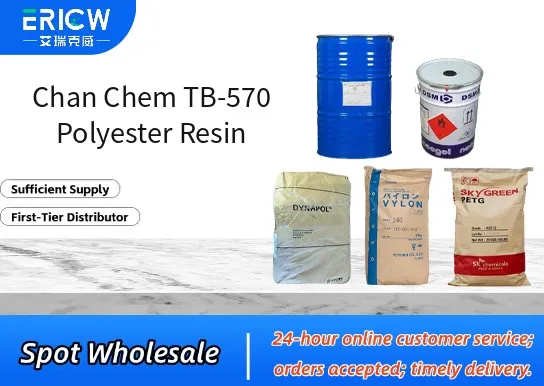
Q1: What is the primary application of TB-570 in polyester resin systems?
A: TB-570 is a reactive diluent and viscosity modifier specifically designed for unsaturated polyester resins. It is commonly used to reduce formulation viscosity without significantly compromising crosslink density or final mechanical performance, particularly in casting, laminating, and pultrusion applications.
Q2: Is TB-570 compatible with standard peroxide initiators like MEKP and BPO?
A: Yes, TB-570 exhibits good compatibility with common free-radical initiators including methyl ethyl ketone peroxide (MEKP) and benzoyl peroxide (BPO). It does not interfere with standard curing kinetics under typical processing conditions.
Q3: How does TB-570 compare to styrene in terms of volatility and odor profile?
A: TB-570 has significantly lower volatility and a milder odor compared to styrene, making it suitable for formulations where reduced VOC emissions and improved workplace handling are priorities—without requiring major re-engineering of existing resin systems.
Q4: Can TB-570 be used in high-gloss gel coat formulations?
A: Yes, TB-570 supports excellent surface aesthetics in gel coats, contributing to high gloss retention and reduced surface tackiness after cure—provided proper inhibitor levels and post-cure protocols are maintained.
Contact With Us:
E-mail: wangxingqiang@ericwchem.com
Have a Questions? Call Us:
Add:
Building A1, Jiete Industrial Park, Huangpu District, Guangzhou City, Guangdong Province, China