English
 Español
 tiếng việt
 русский
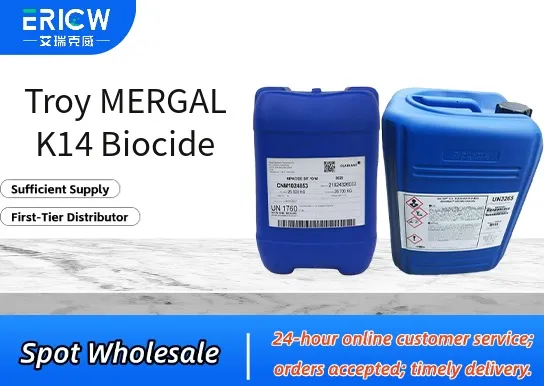
Highly effective broad-spectrum biocide against bacteria, fungi, and algae in water-based industrial systems.
Stable across a wide pH range (pH 4–10), ensuring consistent performance in diverse formulation environments.
Low toxicity profile with favorable environmental and regulatory acceptance for industrial use.
Excellent compatibility with common surfactants, thickeners, and co-biocides in paint, coating, and adhesive formulations.
Non-oxidizing mode of action, minimizing corrosion risk to metal components in recirculating systems.
Preservative in architectural and industrial waterborne paints and coatings.
Microbial control agent in latex emulsions and polymer dispersions.
Bio-stabilizer in adhesives, sealants, and caulking compounds.
Protective additive in pigment preparations and colorant concentrates.
Preservation solution for aqueous metalworking fluid concentrates.
| Chemical Type | Isothiazolinone-based biocide blend |
| Product Form | Clear to slightly hazy liquid |
| Appearance | Pale yellow to amber liquid |
| Primary Applications | Preservation of water-based coatings, adhesives, and dispersions |
| Key Features | Broad-spectrum efficacy, pH stability, low volatility |
| Benefits | Extended product shelf life, reduced spoilage risk, minimal impact on formulation properties |
| Recommended Use Level | 0.05–0.2% w/w active in final product |
| Storage Conditions | Store at 5–30°C; protect from freezing and direct sunlight |
Q1: What is the primary mode of action for Troy MERGAL K14 Biocide?
A: Troy MERGAL K14 Biocide functions primarily as a broad-spectrum preservative through membrane disruption and interference with essential microbial metabolic processes, effectively controlling bacteria, yeasts, and molds in water-based industrial formulations.
Q2: In which types of formulations is Troy MERGAL K14 typically used?
A: It is commonly employed in water-miscible metalworking fluids, aqueous cleaning solutions, industrial coatings, latex paints, adhesives, and other water-based process and maintenance fluids where long-term microbiological stability is required.
Q3: How should Troy MERGAL K14 be incorporated into a formulation?
A: It is recommended to add Troy MERGAL K14 during the final stage of manufacturing, after pH adjustment and cooling, to ensure optimal stability and efficacy. Pre-dilution with water or a compatible solvent may facilitate uniform dispersion, especially in viscous systems.
Q4: Is Troy MERGAL K14 compatible with common surfactants and additives?
A: Yes, it demonstrates good compatibility with anionic, nonionic, and amphoteric surfactants, as well as typical thickeners, defoamers, and corrosion inhibitors found in industrial fluid formulations—though compatibility testing under actual use conditions is always advised.
Q5: What safety and handling considerations apply to Troy MERGAL K14?
A: As with all biocidal agents, appropriate personal protective equipment (PPE) such as gloves and eye protection should be worn during handling. It is classified as an irritant; avoid inhalation of mists and direct skin or eye contact. Refer to the Safety Data Sheet (SDS) for detailed toxicological and first-aid information.
Contact With Us:
E-mail: wangxingqiang@ericwchem.com
Have a Questions? Call Us:
Add:
Building A1, Jiete Industrial Park, Huangpu District, Guangzhou City, Guangdong Province, China