English
 Español
 tiếng việt
 русский
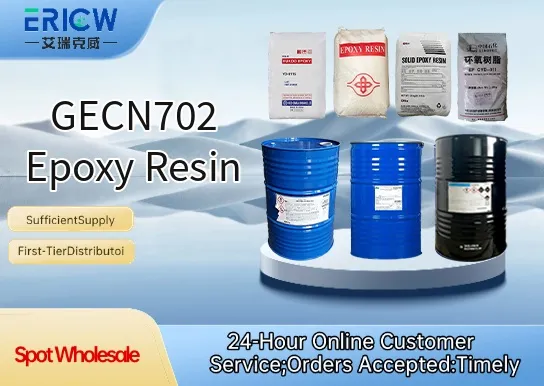
High reactivity with amine and anhydride hardeners, enabling rapid cure at ambient or elevated temperatures.
Excellent adhesion to metals, composites, and cured polymer substrates without extensive surface pretreatment.
Low viscosity (12,000–15,000 cP at 25°C) for improved wetting, impregnation, and ease of processing in casting and laminating.
Superior electrical insulation properties with high dielectric strength and volume resistivity.
Good chemical resistance to alkalis, dilute acids, and common solvents after full cure.
Electrical potting and encapsulation for transformers, sensors, and power electronics.
Structural adhesive formulations for aerospace and automotive bonding.
Matrix resin for fiber-reinforced composites in wind turbine blades and industrial tooling.
Casting compounds for high-voltage insulators and decorative art pieces.
Coating systems for corrosion protection of steel infrastructure and marine equipment.
| Chemical Type | Bisphenol-F based liquid epoxy resin |
| Product Form | Clear to pale yellow viscous liquid |
| Appearance | Homogeneous, transparent, free from gels or suspended particles |
| Epoxy Equivalent Weight (EEW) | 185–195 g/eq |
| Viscosity (25°C) | 12,000–15,000 cP |
| Chloride Content | < 800 ppm |
| Softening Point | Not applicable (liquid at room temperature) |
| Storage Stability | 12 months at < 30°C in unopened original containers |
Q1: What is the primary functional role of GECN702 in epoxy formulations?
A: GECN702 functions as a reactive diluent and viscosity modifier, enabling improved processability—especially in high-solids or solvent-free systems—while maintaining epoxy functionality and contributing to crosslink density upon curing.
Q2: Is GECN702 suitable for applications requiring FDA-compliant coatings or food-contact surfaces?
A: GECN702 is not pre-approved for direct food-contact use under FDA or equivalent global food safety regulations. Its suitability must be validated case-by-case within the final cured system, considering formulation, cure conditions, and intended exposure scenario.
Q3: How does GECN702 compare to conventional glycidyl ether diluents in terms of reactivity and thermal stability?
A: GECN702 exhibits moderate reactivity—lower than monofunctional aliphatic glycidyl ethers but higher than many aromatic diluents—supporting balanced pot life and cure speed. Its molecular structure contributes to enhanced thermal resistance in the cured network compared to standard linear alkyl variants.
Q4: Can GECN702 be used in UV-curable epoxy systems?
A: GECN702 is not inherently UV-active and is not designed for cationic UV curing without additional photoinitiators. It may be incorporated into hybrid thermal/UV systems where thermal post-cure is employed, but performance depends on full formulation compatibility and cure protocol validation.
Contact With Us:
E-mail: wangxingqiang@ericwchem.com
Have a Questions? Call Us:
Add:
Building A1, Jiete Industrial Park, Huangpu District, Guangzhou City, Guangdong Province, China