English
 Español
 tiếng việt
 русский
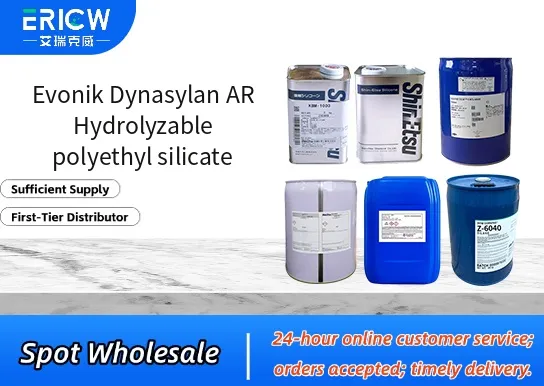
Hydrolyzable ethyl silicate structure enables controlled in-situ silica network formation under mild acidic or neutral conditions.
High purity and low chloride content ensure compatibility with sensitive catalysts and metal substrates.
Excellent hydrolytic stability in sealed, anhydrous storage—extends shelf life without premature condensation.
Reactive silanol groups provide strong covalent bonding to hydroxylated surfaces (e.g., glass, metals, minerals).
Tailored molecular weight distribution supports balanced reactivity and film-forming performance in sol-gel coatings.
Anti-corrosion primers for aluminum, steel, and magnesium alloys in automotive and aerospace components.
Hybrid sol-gel binders in high-performance ceramic and refractory coatings.
Surface modification agents for silica-based nanocomposites and functional fillers.
Adhesion promoters in UV- and thermally curable hybrid organic-inorganic coatings.
Consolidation agents for porous mineral substrates such as sandstone and limestone in conservation technology.
| Chemical Type | Polyethyl silicate (hydrolyzable) |
| Product Form | Clear, colorless to pale yellow liquid |
| Appearance | Homogeneous, low-viscosity liquid |
| Primary Applications | Sol-gel precursors, adhesion promotion, corrosion protection, mineral consolidation |
| Key Features | Controlled hydrolysis, surface-reactive Si–OH generation, metal-substrate compatibility |
| Benefits | Improved coating durability, enhanced interfacial bonding, reduced VOC vs. traditional silanes |
| Storage Conditions | Store in tightly sealed containers under dry, inert atmosphere at 5–25 °C |
| Handling Precautions | Use in well-ventilated areas; avoid contact with moisture prior to application |
Contact With Us:
E-mail: wangxingqiang@ericwchem.com
Have a Questions? Call Us:
Add:
Building A1, Jiete Industrial Park, Huangpu District, Guangzhou City, Guangdong Province, China