English
 Español
 tiếng việt
 русский
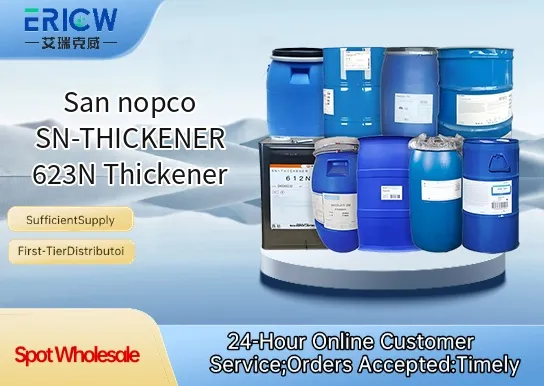
Non-ionic associative thickener delivering excellent rheology control in water-based systems.
High shear-thinning behavior for improved application performance and leveling.
Excellent compatibility with anionic surfactants, co-solvents, and common preservatives.
Stable viscosity retention across pH range of 4–10 without requiring neutralization.
Low-odor, non-volatile formulation suitable for low-VOC and eco-label compliant formulations.
Architectural coatings including interior and exterior latex paints.
Industrial maintenance coatings and protective primers.
Water-based adhesives and construction sealants.
Carpet and textile treatment formulations.
Agrochemical suspension concentrates (SC) and ready-to-use sprays.
| Chemical Type | Non-ionic hydrophobically modified ethoxylated urethane (HEUR) |
| Product Form | Clear to slightly hazy viscous liquid |
| Appearance | Off-white to pale yellow liquid |
| pH (1% aqueous solution) | 6.5–7.5 |
| Active Content | 30.0 ± 1.0 wt% |
| Density (25°C) | 1.02–1.06 g/cm³ |
| Solubility | Water-miscible; forms clear solutions above 0.3% concentration |
| Storage Stability | 12 months at 5–30°C in sealed original container |
Q1: What types of systems is SN-THICKENER 623N most commonly used in?
A: SN-THICKENER 623N is primarily formulated for use in water-based industrial coatings, architectural paints, and construction-related slurries where stable, non-drip rheology and good sag resistance are required. It performs well in both acrylic and styrene-acrylic dispersions.
Q2: How does SN-THICKENER 623N differ from associative thickeners like HEUR or HASE types?
A: SN-THICKENER 623N is a non-ionic, hydrophobically modified alkali-swellable emulsion (HASE) thickener, offering balanced viscosity development, improved shear recovery, and reduced sensitivity to surfactants compared to traditional ASE types—while maintaining compatibility with common paint additives and pH adjustment agents.
Q3: What is the recommended method for incorporating SN-THICKENER 623N into a formulation?
A: It is typically added during the let-down stage, after pigment dispersion and pH adjustment. Pre-dilution with water or a compatible solvent is recommended to ensure uniform dispersion. Avoid direct addition to highly acidic or strongly alkaline phases without prior neutralization.
Q4: Does SN-THICKENER 623N affect film formation or gloss in finished coatings?
A: When used within typical dosage ranges, SN-THICKENER 623N generally supports good film integrity and has minimal impact on gloss retention. Its low-VOC profile and compatibility with common film-forming resins help maintain optical and mechanical performance.
Contact With Us:
E-mail: wangxingqiang@ericwchem.com
Have a Questions? Call Us:
Add:
Building A1, Jiete Industrial Park, Huangpu District, Guangzhou City, Guangdong Province, China