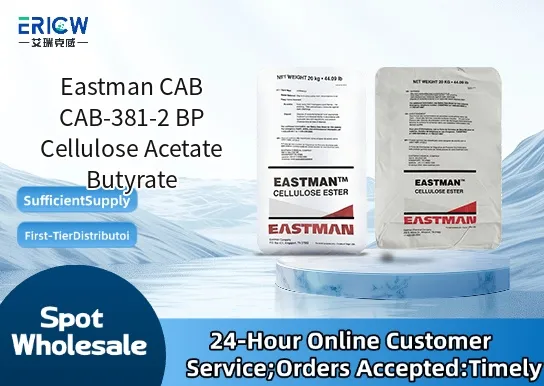
Features Of Eastman CAB CAB-381-2 BP Cellulose Acetate Butyrate
Excellent clarity and gloss for high-end coating and film applications.
Good compatibility with a broad range of resins, plasticizers, and pigments.
Enhanced toughness and impact resistance compared to standard cellulose acetate.
Low moisture absorption for improved dimensional stability in humid environments.
Good solution viscosity control and film-forming capability in common organic solvents.
Typical Applications Of Eastman CAB CAB-381-2 BP Cellulose Acetate Butyrate
Automotive clearcoats and basecoat binders.
Industrial maintenance and protective coatings.
Overprint varnishes for flexible packaging and premium labels.
Tool handles, sporting goods, and consumer electronics housings requiring durable finishes.
Adhesive modifiers for pressure-sensitive and laminating adhesives.
Specifications Of Eastman CAB CAB-381-2 BP Cellulose Acetate Butyrate
| Chemical Type | Cellulose acetate butyrate (CAB) |
| Product Form | Free-flowing white to off-white granules |
| Appearance | White to light tan granular solid |
| Primary Applications | Coatings, inks, adhesives, and thermoplastic compounds |
| Key Features | High clarity, low moisture sensitivity, excellent toughness |
| Benefits | Improved film integrity, solvent resistance, and substrate adhesion |
| Solubility | Soluble in esters, ketones, chlorinated hydrocarbons, and some aromatic hydrocarbons |
| Storage Conditions | Store in cool, dry place; protect from moisture and direct sunlight |
Eastman CAB CAB-381-2 BP Cellulose Acetate Butyrate – Frequently Asked Questions (FAQ)
Q1: What are the primary performance advantages of CAB-381-2 BP compared to other cellulose esters?
A: CAB-381-2 BP offers an optimized balance of solubility in common organic solvents (including ketones, esters, and some alcohols), good film-forming capability, and enhanced compatibility with a wide range of resins and plasticizers—making it especially suitable for demanding coating and ink applications where clarity, toughness, and low moisture sensitivity are critical.
Q2: Is CAB-381-2 BP suitable for use in food-contact coatings or inks?
A: CAB-381-2 BP is manufactured under Eastman’s stringent quality controls and is commonly used in coatings and inks intended for indirect food contact applications. Formulators must validate final compliance based on their specific formulation, processing conditions, and applicable regulatory requirements in the target market.
Q3: How does CAB-381-2 BP contribute to rheology and leveling in solvent-borne coatings?
A: Due to its moderate molecular weight and butyryl content, CAB-381-2 BP provides effective viscosity control and improves flow/leveling without excessive thixotropy. It helps reduce orange peel and enhances gloss uniformity, particularly in high-solids or fast-drying systems.
Q4: Can CAB-381-2 BP be blended with acrylic or polyester resins?
A: Yes—CAB-381-2 BP exhibits excellent compatibility with many acrylics, polyesters, and urethane resins. It is frequently used as a co-resin to improve substrate adhesion, flexibility, and resistance to blush or solvent pop during cure.
 English
 Español
 tiếng việt
 русский