English
 Español
 tiếng việt
 русский
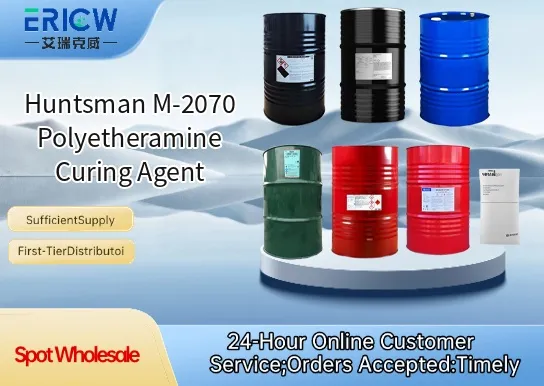
Low-viscosity liquid enabling excellent processability and easy handling in epoxy formulations.
Fast-reacting polyetheramine chemistry delivering rapid cure at ambient or elevated temperatures.
Provides outstanding flexibility, impact resistance, and toughness in cured epoxy systems.
Excellent compatibility with standard diglycidyl ether of bisphenol-A (DGEBA) and other epoxy resins.
Low color and low volatility support high-gloss finishes and reduced VOC emissions.
Structural adhesives for automotive and aerospace bonding.
High-performance coatings for industrial maintenance and marine environments.
Electrical encapsulation and potting compounds requiring thermal and mechanical resilience.
Composite matrix resins for wind turbine blades and lightweight structural components.
Flooring and grouting systems demanding rapid turnaround and durable service life.
| Chemical Type | Polyetheramine (tertiary amine-terminated) |
| Product Form | Liquid |
| Appearance | Clear, pale yellow to amber liquid |
| Primary Applications | Epoxy curing agent for adhesives, coatings, composites, and encapsulants |
| Key Features | Ambient-cure capability, low viscosity, flexible cured network |
| Benefits | Improved toughness, reduced mixing viscosity, enhanced moisture resistance |
| Storage Stability | Stable under dry, cool conditions (≤25°C); protect from moisture |
Q1: What is the primary function of M-2070 in epoxy formulations?
A: M-2070 is a polyetheramine-based curing agent designed to react with epoxy resins to form crosslinked thermoset networks. It imparts flexibility, low viscosity, and excellent moisture resistance while enabling room-temperature or mild-heat cure profiles.
Q2: How does M-2070 compare to traditional aliphatic amines in terms of pot life and reactivity?
A: Due to its polyether backbone, M-2070 offers extended pot life compared to highly reactive aliphatic diamines—especially at ambient temperatures—while maintaining sufficient reactivity for practical processing windows in coatings, adhesives, and composites.
Q3: Is M-2070 suitable for high-humidity or underwater cure applications?
A: Yes—its hydrophilic polyether structure enhances compatibility with moisture and supports reliable curing even under high relative humidity or damp-surface conditions, making it well-suited for marine repair, concrete primers, and field-applied protective systems.
Q4: What types of epoxy resins is M-2070 typically blended with?
A: M-2070 is commonly used with standard liquid bisphenol-A and bisphenol-F epoxies, as well as novolac and cycloaliphatic epoxies. Its low viscosity and good miscibility simplify formulation across a broad range of molecular weights and functionality.
Q5: How should M-2070 be stored to maintain performance stability?
A: Store in tightly sealed containers under dry, cool conditions (preferably below 30 °C) and protect from prolonged exposure to air and moisture. Avoid freezing, and always inspect for clarity and absence of phase separation before use.
Contact With Us:
E-mail: wangxingqiang@ericwchem.com
Have a Questions? Call Us:
Add:
Building A1, Jiete Industrial Park, Huangpu District, Guangzhou City, Guangdong Province, China