English
 Español
 tiếng việt
 русский
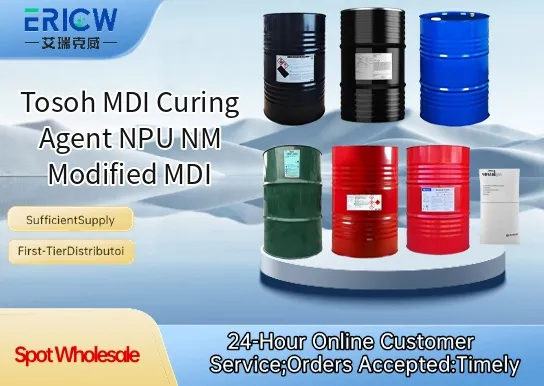
High reactivity with polyols and amines, enabling rapid gelation and short demold times.
Low monomeric MDI content (< 0.5 wt%), enhancing workplace safety and regulatory compliance.
Excellent hydrolytic stability due to controlled uretonimine modification and inhibited self-polymerization.
Tailored viscosity (150–250 mPa·s at 25°C) for precise metering and uniform dispersion in multi-component systems.
Consistent batch-to-batch performance supported by Tosoh’s ISO 9001-certified manufacturing and strict QC protocols.
High-performance rigid polyurethane insulation foams for refrigeration and building envelope applications.
Reaction injection molding (RIM) and reinforced RIM (RRIM) components in automotive interior and structural parts.
Cast elastomer systems requiring fast cure cycles and high abrasion resistance, such as industrial rollers and mining screens.
Two-component polyurethane adhesives and sealants for demanding transportation and construction bonding.
Coating resins for protective industrial topcoats where chemical resistance and rapid through-cure are critical.
| Chemical Type | Modified diphenylmethane diisocyanate (MDI) oligomer blend |
| Product Form | Liquid |
| Appearance | Clear, pale yellow to amber liquid |
| NCO Content (wt%) | 27.5–28.5 |
| Viscosity at 25°C (mPa·s) | 180–230 |
| Specific Gravity (25°C) | 1.21–1.24 |
| Monomeric MDI Content (wt%) | ≤ 0.4 |
| Storage Stability | ≥ 6 months at 25°C in sealed, dry conditions |
Q1: What is the primary functional advantage of NPU NM Modified MDI compared to conventional MDI-based curing agents?
A: NPU NM Modified MDI offers enhanced reactivity control and improved compatibility with sensitive polyol systems, particularly in moisture-cure and one-component polyurethane formulations. Its modified structure reduces volatility and provides more predictable gel times without compromising final crosslink density.
Q2: Is NPU NM suitable for use in low-VOC or high-solids coating systems?
A: Yes — due to its low monomeric MDI content and tailored molecular weight distribution, NPU NM supports formulation strategies aimed at VOC reduction and higher solids content, while maintaining good pot life and film formation characteristics.
Q3: How does NPU NM perform in humid environments during application?
A: While all isocyanate curing agents react with ambient moisture, NPU NM’s modified structure provides a more balanced sensitivity — enabling sufficient open time for processing under typical industrial conditions, while still achieving reliable cure development even with moderate humidity exposure.
Q4: Can NPU NM be blended with other isocyanate curing agents or chain extenders?
A: Yes — NPU NM is generally compatible with common aromatic and aliphatic isocyanates, as well as conventional diamine or diol chain extenders. However, compatibility and reaction kinetics should be verified experimentally within the target resin system to ensure optimal performance and storage stability.
Q5: What handling precautions are recommended for safe storage and processing?
A: As with all isocyanate-containing materials, NPU NM should be stored under dry, inert conditions (e.g., nitrogen blanket) and protected from moisture, heat, and strong bases. Use appropriate PPE including nitrile gloves, chemical-resistant goggles, and respiratory protection when handling in non-ventilated areas.
Contact With Us:
E-mail: wangxingqiang@ericwchem.com
Have a Questions? Call Us:
Add:
Building A1, Jiete Industrial Park, Huangpu District, Guangzhou City, Guangdong Province, China