English
 Español
 tiếng việt
 русский
High-intensity fluorescence under UV-A (365 nm) and daylight conditions.
Excellent thermal stability up to 220°C, suitable for high-temperature processing.
Good compatibility with acrylic, polyester, and polyurethane resin systems.
Low migration tendency in polymer matrices, ensuring long-term color fidelity.
Non-halogenated formulation compliant with RoHS and REACH regulatory requirements.
Security inks for banknotes, passports, and tax stamps.
Fluorescent coatings for safety signage and emergency egress markings.
Special-effect inks in packaging and premium label printing.
UV-responsive additives in automotive interior trim and decorative plastics.
Functional pigments in industrial marking tapes and inspection aids.
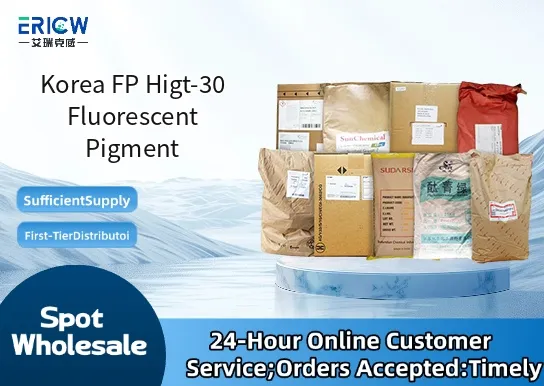
| Chemical Type | Organic fluorescent dye dispersed in polymeric carrier |
| Product Form | Free-flowing fine powder |
| Appearance | Yellow-orange powder with bright green-yellow fluorescence |
| Primary Applications | Plastics, inks, coatings, and thermoplastic elastomers |
| Key Features | UV-stable, non-bleeding, solvent-resistant dispersion |
| Benefits | Enhanced visibility, regulatory compliance, easy incorporation |
| Recommended Loading Range | 0.5–3.0 wt% depending on substrate and required intensity |
| Storage Conditions | Keep in cool, dry place; protect from direct sunlight and moisture |
Q1: What types of polymer systems is Korea FP Higt-30 compatible with?
A: Korea FP Higt-30 is formulated for compatibility with a broad range of thermoplastics and thermosets, including ABS, PS, PVC, PET, and acrylics. It exhibits good thermal stability during standard extrusion and injection molding processes, though performance may vary depending on resin polarity and processing temperature.
Q2: How does this pigment perform under UV exposure and outdoor weathering?
A: Korea FP Higt-30 delivers strong initial fluorescence but is not inherently UV-stabilized. For extended outdoor applications, co-addition of appropriate UV absorbers and HALS stabilizers is recommended to mitigate fading and maintain chromatic intensity over time.
Q3: What is the typical dosage range for achieving optimal fluorescence in plastic masterbatches?
A: Dosage depends on substrate, desired brightness level, and processing method, but it is typically used at low concentrations—generally ranging from 0.1% to 2% by weight in masterbatch formulations. Higher loadings may improve intensity but can affect dispersion quality and mechanical properties.
Q4: Is special handling or dispersion equipment required during compounding?
A: Standard high-shear compounding equipment (e.g., twin-screw extruders) is sufficient when proper feeding and melt temperature control are maintained. Pre-drying is not mandatory but recommended if ambient humidity is high, as moisture may impact dispersion consistency in hygroscopic matrices.
Q5: Can Korea FP Higt-30 be used in food-contact or medical-grade polymers?
A: Korea FP Higt-30 is intended for general industrial and decorative applications. It is not pre-qualified for food-contact or medical device use; customers must conduct full regulatory evaluation—including extractables testing and compliance verification—against applicable regional requirements before such deployment.
Contact With Us:
E-mail: wangxingqiang@ericwchem.com
Have a Questions? Call Us:
Add:
Building A1, Jiete Industrial Park, Huangpu District, Guangzhou City, Guangdong Province, China