English
 Español
 tiếng việt
 русский
Broad-spectrum activity against key fungal pathogens including Ascomycetes, Basidiomycetes, and Deuteromycetes.
Systemic and translaminar movement ensures protective and curative action within plant tissues.
Low mammalian toxicity profile, classified as EPA Category III for acute oral, dermal, and inhalation exposure.
Compatible with major adjuvants and commonly used insecticides and herbicides in integrated pest management programs.
Stable under standard storage conditions (15–30°C), with shelf life exceeding 24 months in original unopened packaging.
Preventive and curative treatment of powdery mildew in cucurbits and ornamental crops.
Control of early blight (Alternaria solani) in tomato and potato production systems.
Management of gray mold (Botrytis cinerea) in greenhouse strawberries and high-value vegetables.
Foliar protection against rust diseases (Puccinia spp.) in soybean and wheat under high-humidity conditions.
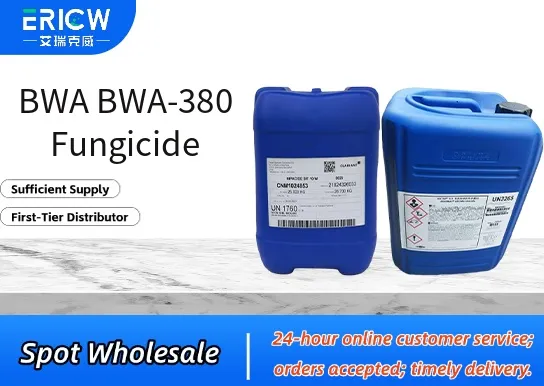
| Chemical Type | Triazole-class fungicide (active ingredient: difenoconazole) |
| Product Form | Emulsifiable concentrate (EC) |
| Appearance | Amber to light brown homogeneous liquid |
| Active Ingredient Concentration | 380 g/L difenoconazole |
| Primary Applications | Foliar spray for field and protected horticulture crops |
| Key Features | Systemic action, rainfastness >4 hours, UV-stabilized formulation |
| Benefits | Extended residual control, flexible application timing, resistance management support |
| Storage Conditions | Store in original container at 5–35°C, away from direct sunlight and moisture |
Q1: What types of fungi does BWA BWA-380 effectively control?
A: BWA BWA-380 is formulated to provide broad-spectrum protection against common spoilage and growth-related fungi, including Aspergillus, Penicillium, and Cladosporium species, particularly in non-food-contact industrial systems where microbial stability is critical.
Q2: In which industrial applications is BWA BWA-380 typically used?
A: It is commonly incorporated into water-based industrial fluids such as metalworking coolants, latex paints, adhesives, and construction coatings—where long-term preservation against fungal degradation is required under varying pH and temperature conditions.
Q3: How should BWA BWA-380 be incorporated into a formulation?
A: BWA BWA-380 is compatible with many aqueous systems and is typically added during the final stage of manufacturing. Dosage depends on formulation requirements but generally ranges from 0.1% to 2% by weight, with optimal performance achieved when uniformly dispersed and pH stabilized between 6.0 and 9.5.
Q4: Is BWA BWA-380 suitable for use in food-contact or pharmaceutical applications?
A: No—BWA BWA-380 is intended exclusively for non-food-contact industrial applications. It is not approved for direct use in food packaging, pharmaceutical excipients, or personal care products regulated under health authority guidelines for human exposure.
Contact With Us:
E-mail: wangxingqiang@ericwchem.com
Have a Questions? Call Us:
Add:
Building A1, Jiete Industrial Park, Huangpu District, Guangzhou City, Guangdong Province, China