English
 Español
 tiếng việt
 русский
High-solids, low-viscosity unsaturated polyester resin for efficient processing and reduced VOC emissions.
Excellent compatibility with standard styrene monomers and common accelerators/catalysts.
Superior mechanical strength and dimensional stability in cured laminates.
Good weather resistance and UV stability for outdoor applications.
Consistent batch-to-batch performance supporting reliable industrial-scale production.
Fiberglass-reinforced plastic (FRP) tanks and vessels for chemical storage.
Marine components including boat hulls, decks, and structural panels.
Transportation parts such as truck body panels and bus interior linings.
Architectural cladding, façade elements, and decorative GRP profiles.
| Chemical Type | Unsaturated polyester resin |
| Product Form | Liquid |
| Appearance | Clear to pale yellow viscous liquid |
| Solids Content (wt%) | ≈ 68–72% |
| Viscosity (mPa·s, 25°C) | 1,200–1,800 |
| Styrene Content (wt%) | ≈ 28–32% |
| Density (g/cm³, 25°C) | 1.10–1.14 |
| Primary Applications | FRP laminating, spray-up, and centrifugal casting |
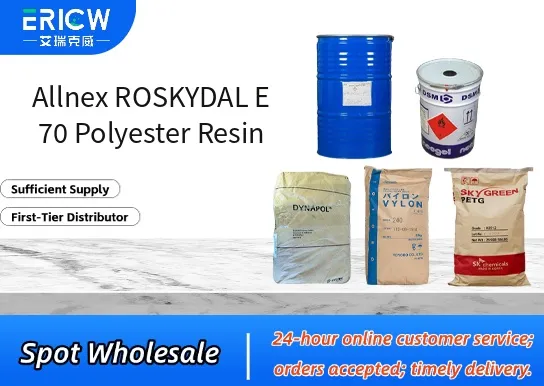
Q1: What is the primary function of ROSKYDAL E 70 in polyester-based coating systems?
A: ROSKYDAL E 70 is a reactive polyester resin designed to serve as a crosslinker or co-resin in thermosetting polyester systems, enhancing film hardness, chemical resistance, and thermal stability without requiring external catalysts for cure.
Q2: Is ROSKYDAL E 70 suitable for high-gloss, weather-resistant topcoats?
A: Yes — it is commonly formulated into high-performance coil and general industrial coatings where excellent gloss retention, UV stability, and resistance to chalking are required, especially when combined with appropriate pigments and stabilizers.
Q3: How does ROSKYDAL E 70 differ from conventional saturated polyester resins used in powder coatings?
A: Unlike standard saturated polyesters, ROSKYDAL E 70 features a tailored molecular architecture with controlled acid value and low melt viscosity, enabling improved flow, reduced curing temperature sensitivity, and enhanced compatibility with triglycidyl isocyanurate (TGIC) and hydroxyalkyl amide (HAA) curing agents.
Q4: Can ROSKYDAL E 70 be used in solvent-borne and solvent-free systems?
A: Yes — it demonstrates good solubility in common aromatic and ester solvents and is also compatible with high-solids and 100% solids formulations, supporting flexible process adaptation across different application technologies.
Q5: What safety and handling precautions should be observed during processing?
A: As with most reactive polyester resins, standard industrial hygiene practices apply — including adequate ventilation, avoidance of prolonged skin contact, and use of appropriate PPE such as nitrile gloves and safety goggles. Refer to the Safety Data Sheet for detailed handling and storage guidance.
Contact With Us:
E-mail: wangxingqiang@ericwchem.com
Have a Questions? Call Us:
Add:
Building A1, Jiete Industrial Park, Huangpu District, Guangzhou City, Guangdong Province, China