English
 Español
 tiếng việt
 русский
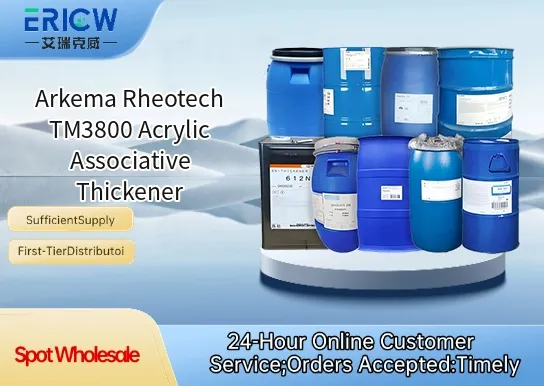
Delivers high-shear viscosity control for excellent sag resistance and brush/roller application performance.
Provides outstanding water retention and film formation in waterborne systems.
Offers robust rheology stability across a broad pH range (4–10) without requiring neutralization.
Enables low foaming and good compatibility with common surfactants, co-thickeners, and biocides.
Delivers efficient thickening at low dosage levels, supporting formulation cost optimization.
Architectural interior and exterior paints.
Waterborne industrial maintenance coatings.
Decorative wall coatings and textured finishes.
Water-based primers and undercoats.
Low-VOC and zero-VOC compliant coating systems.
| Chemical Type | Acrylic associative polymeric thickener |
| Product Form | Aqueous dispersion |
| Appearance | Opaque white liquid |
| pH (as received) | 3.5 – 4.5 |
| Non-Volatile Content (wt%) | 27.0 – 29.0% |
| Viscosity (Brookfield RVT, Spindle #3, 20 rpm, 25°C) | 500 – 2,500 mPa·s |
| Primary Applications | Waterborne architectural and industrial coatings |
| Key Features | High-shear thickening, pH-independent performance, low foaming |
Q1: What types of formulations is Rheotech TM3800 best suited for?
A: Rheotech TM3800 is specifically designed for waterborne architectural and industrial coatings, including interior and exterior paints, primers, and low-VOC decorative systems where high-shear viscosity control, excellent sag resistance, and good leveling are required.
Q2: How does TM3800 differ from conventional cellulosic or non-associative acrylic thickeners?
A: As an associative thickener, TM3800 functions via hydrophobic interactions between polymer chains and surfactants or other hydrophobic domains in the formulation, delivering superior rheology control—especially enhanced mid-to-high shear viscosity and improved spatter resistance—compared to non-associative thickeners that rely solely on chain entanglement.
Q3: Is Rheotech TM3800 compatible with common co-thickeners and rheology modifiers?
A: Yes, TM3800 is generally compatible with other associative thickeners, fumed silica, and certain urethane thickeners, enabling synergistic rheology tuning. However, compatibility should be verified experimentally in each specific formulation due to sensitivity to surfactant type, pH, and ionic strength.
Q4: What is the recommended addition method for optimal performance?
A: For best results, TM3800 should be added during the let-down stage, after dispersants, pigments, and base binders are well incorporated. Pre-dilution with water or a compatible solvent is recommended to ensure uniform dispersion and avoid localized overdosing or viscosity spikes.
Q5: Does TM3800 require pH adjustment for activation or stability?
A: While TM3800 performs effectively across a broad pH range (typically pH 6–10), optimal thickening efficiency and long-term storage stability are achieved in mildly alkaline conditions (pH ~7.5–9.0). Formulators should monitor pH during production and adjust if necessary using common alkaline agents such as AMP-95 or NaOH.
Contact With Us:
E-mail: wangxingqiang@ericwchem.com
Have a Questions? Call Us:
Add:
Building A1, Jiete Industrial Park, Huangpu District, Guangzhou City, Guangdong Province, China