English
 Español
 tiếng việt
 русский
Excellent melt processability for high-speed extrusion and injection molding
Outstanding flexibility and low-temperature impact resistance
Superior compatibility with polypropylene (PP) and polyethylene (PE)
Low density and high elasticity for lightweight, soft-touch applications
Good thermal stability and consistent rheological behavior
PP-based thermoplastic elastomer (TPE) compounds for automotive interior parts
Flexible packaging films requiring seal integrity and toughness
Soft-grip overmolding on rigid plastic components
Medical tubing and disposable device components
Footwear midsoles and sports equipment components
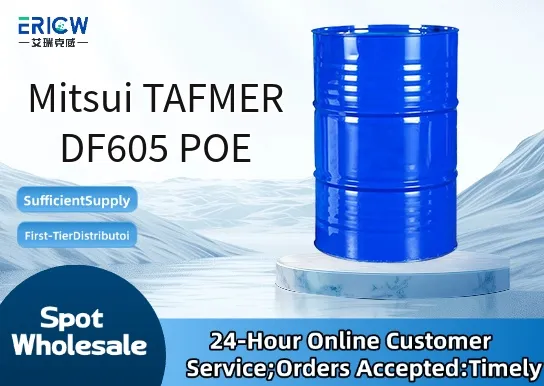
| Chemical Type | Ethylene-octene copolymer (POE) |
| Product Form | Pellets |
| Appearance | Off-white to light beige cylindrical pellets |
| Primary Applications | PP/PE modification, soft-touch overmolding, flexible film blends |
| Key Features | High elasticity, excellent PP compatibility, low density (~0.87 g/cm³) |
| Benefits | Improved impact strength, enhanced processability, reduced part weight |
| Melt Flow Rate (MFR, 190°C/2.16 kg) | 5.0–7.0 g/10 min |
| Octene Content | ~12–14 wt% |
Q1: What is the primary function of TAFMER DF605 in polymer blends?
A: TAFMER DF605 is an ethylene–octene copolymer designed primarily as a compatibilizer and impact modifier—especially for polyolefin-based systems such as PP/PE blends, where it improves interfacial adhesion, ductility, and low-temperature toughness without significantly compromising stiffness or processability.
Q2: Is TAFMER DF605 suitable for use in food-contact applications?
A: TAFMER DF605 is manufactured under strict quality control and is commonly used in food packaging films and containers where regulatory compliance is required; however, final suitability depends on the complete formulation, processing conditions, and applicable regional regulations—end users must conduct their own evaluation and obtain necessary approvals.
Q3: How does TAFMER DF605 differ from standard EPR or EPDM elastomers in thermoplastic applications?
A: Unlike traditional diene-based elastomers, TAFMER DF605 features a saturated backbone with uniform comonomer distribution, offering superior thermal stability, oxidative resistance, and compatibility with polyolefins—making it particularly effective in melt-blended TPOs and soft-touch compounds where consistent dispersion and long-term performance are critical.
Q4: What processing methods are recommended for incorporating TAFMER DF605 into formulations?
A: TAFMER DF605 is readily processable via conventional thermoplastic techniques including extrusion, injection molding, and blow molding; it exhibits good melt flow and thermal stability, enabling efficient dispersion in both single- and multi-screw extruders—typically used at low concentrations to achieve targeted property enhancements.
Contact With Us:
E-mail: wangxingqiang@ericwchem.com
Have a Questions? Call Us:
Add:
Building A1, Jiete Industrial Park, Huangpu District, Guangzhou City, Guangdong Province, China