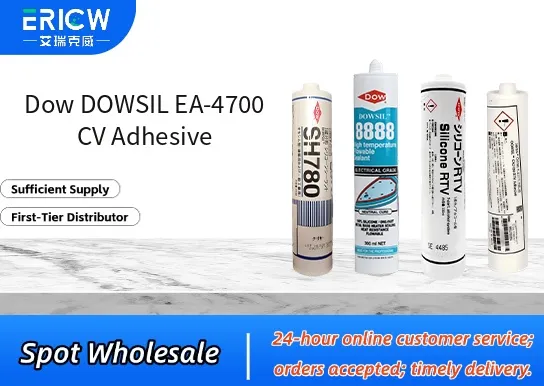
Features Of Dow DOWSIL EA-4700 CV Adhesive
UV and visible light curable silicone adhesive for rapid, low-heat bonding.
Excellent adhesion to challenging substrates including glass, ceramics, metals, and engineered plastics.
Low modulus and high elongation provide superior stress relief in dynamic or thermally cycled assemblies.
UL 94 V-0 rated for flame resistance—suitable for electronics and safety-critical applications.
Optically clear formulation with stable refractive index for precision optical and display bonding.
Typical Applications Of Dow DOWSIL EA-4700 CV Adhesive
Display module assembly: bonding cover lenses, touch sensors, and OLED/LCD panels.
Mini-LED and micro-LED packaging requiring precise, non-yellowing optical adhesion.
Medical device encapsulation where biocompatibility support and low outgassing are critical.
Automotive interior lighting and sensor housings exposed to thermal cycling and UV exposure.
Consumer electronics assembly including camera modules, wearables, and AR/VR optics.
Specifications Of Dow DOWSIL EA-4700 CV Adhesive
| Chemical Type | UV/Visible Light-Curable Silicone |
| Product Form | Thixotropic Paste |
| Appearance | Optically Clear, Slightly Viscous Gel |
| Primary Applications | Optical Bonding, Display Assembly, Precision Electronics Encapsulation |
| Key Features | Low-Temperature Cure, High Clarity, Thermal Stability (–50 °C to +200 °C) |
| Benefits | Reduced Process Time, No Solvent Emissions, Excellent Dielectric Properties |
| Cure Mechanism | Photocuring (365–405 nm), Optional Thermal Post-Cure Available |
| Shelf Life (Unopened, 2–8 °C) | 12 Months |
Dow DOWSIL EA-4700 CV Adhesive – Frequently Asked Questions (FAQ)
Q1: What is the primary curing mechanism of DOWSIL EA-4700 CV Adhesive?
A: DOWSIL EA-4700 CV Adhesive is a cationic ultraviolet (UV) and visible light-curable adhesive. It polymerizes rapidly upon exposure to appropriate UV/visible light sources in the presence of a photoinitiator system, forming highly crosslinked siloxane networks without generating volatile byproducts.
Q2: Is this adhesive suitable for bonding glass, metal, and engineered plastics in optical or electronic assemblies?
A: Yes — DOWSIL EA-4700 CV Adhesive is specifically formulated for high-precision bonding in optical, sensor, and microelectronics applications. It exhibits excellent adhesion to silica-based substrates (e.g., fused silica, borosilicate glass), anodized aluminum, stainless steel, and many thermoset and thermoplastic polymers commonly used in optoelectronic housings and MEMS packaging.
Q3: How does humidity affect the performance and shelf life of this adhesive?
A: As a cationic system, DOWSIL EA-4700 CV Adhesive is sensitive to moisture and basic contaminants, which can inhibit cure or reduce pot life. For optimal handling and storage, it should be kept sealed under dry, inert conditions (e.g., nitrogen-purged containers) at recommended temperatures. Exposure to ambient humidity during dispensing may require environmental control in production environments.
Q4: Can this adhesive be over-cured, and what are the implications for bondline integrity?
A: Over-curing with excessive UV/visible light dose may lead to increased internal stress and slight embrittlement in thick bondlines, particularly when constrained between dissimilar substrates. For best mechanical reliability, cure parameters (intensity, wavelength, and duration) should be optimized per application geometry and substrate combination using standard process qualification methods.
 English
 Español
 tiếng việt
 русский