English
 Español
 tiếng việt
 русский
High reactivity with epoxy resins enabling rapid cure at ambient temperatures.
Excellent flexibility and impact resistance in cured epoxy systems.
Good chemical resistance, particularly to alkalis and solvents.
Low viscosity for easy handling and improved formulation compatibility.
Low odor and favorable health & safety profile compared to traditional amine curing agents.
Industrial floor coatings requiring durability and fast return-to-service.
Marine and offshore protective coatings for steel substrates.
Concrete repair mortars and structural adhesives.
Electrical encapsulation and potting compounds.
General-purpose epoxy adhesive formulations.
| Chemical Type | Polyamide adduct |
| Product Form | Liquid |
| Appearance | Amber to light brown transparent liquid |
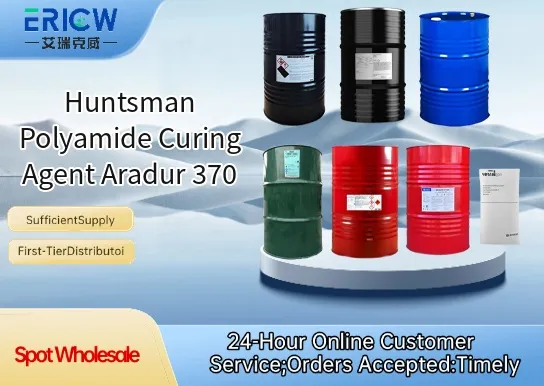
| Primary Applications | Epoxy resin curing agent for coatings, adhesives, and composites |
| Key Features | Ambient-cure capability, flexibility, low volatility |
| Benefits | Reduced VOC, improved worker safety, enhanced toughness |
| Storage Stability | Stable under dry, cool conditions (15–25°C) for ≥12 months |
| Compatibility | Designed for use with standard DGEBA-type epoxy resins |
Q1: What is the primary function of Aradur 370 in epoxy systems?
A: Aradur 370 is a polyamide-based curing agent designed to react with epoxy resins, enabling crosslinking at ambient or slightly elevated temperatures. It delivers balanced pot life, mechanical strength, and chemical resistance—particularly suited for protective coatings and industrial adhesives.
Q2: Is Aradur 370 suitable for high-humidity or damp-surface applications?
A: Yes—Aradur 370 exhibits good moisture tolerance during cure, making it well-suited for application on substrates with moderate surface moisture or in humid environments where conventional amine hardeners may suffer from blushing or poor film formation.
Q3: How does Aradur 370 compare to aliphatic amine curing agents in terms of handling and safety?
A: Compared to low-molecular-weight aliphatic amines, Aradur 370 has significantly lower volatility and reduced skin sensitization potential. Its higher molecular weight and viscous liquid form contribute to improved workplace handling and lower odor intensity.
Q4: Can Aradur 370 be used in food-contact or potable water applications?
A: Aradur 370 is not pre-qualified for direct food-contact or potable water applications. Formulators must conduct full regulatory evaluation—including end-use testing and compliance verification—against applicable regional requirements before such use.
Contact With Us:
E-mail: wangxingqiang@ericwchem.com
Have a Questions? Call Us:
Add:
Building A1, Jiete Industrial Park, Huangpu District, Guangzhou City, Guangdong Province, China