English
 Español
 tiếng việt
 русский
High solids content for reduced VOC emissions and improved coating efficiency.
Excellent pigment wetting and dispersion stability in aqueous systems.
Good alkali resistance, enabling compatibility with cementitious and plaster-based substrates.
Balanced hardness and flexibility for durable film formation without cracking.
Low minimum film formation temperature (MFFT) for reliable performance in ambient-cure applications.
Exterior architectural coatings requiring weather resistance and color retention.
Interior wall paints formulated for low-odor, low-VOC compliance.
Decorative concrete sealers and overlays.
Water-based stucco and textured finish systems.
Primer formulations for masonry and EIFS (Exterior Insulation and Finish Systems).
| Chemical Type | Acrylic copolymer dispersion |
| Product Form | Aqueous dispersion |
| Appearance | White to slightly bluish opaque liquid |
| Solids Content (wt%) | 48.0 ± 1.0% |
| pH (at 25°C) | 8.0 – 9.0 |
| Viscosity (mPa·s, Brookfield RVT, Spindle #3, 20 rpm) | 150 – 400 |
| Minimum Film Formation Temperature (MFFT) | 12°C |
| Particle Size (D50, nm) | 120 – 180 |
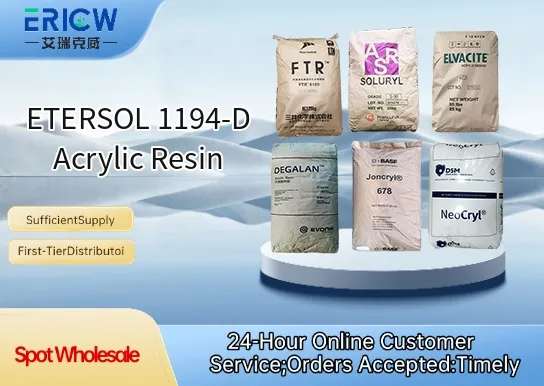
Q1: What is the primary function of ETERSOL 1194-D in coating formulations?
A: ETERSOL 1194-D is a reactive acrylic resin designed to enhance film formation, improve scratch resistance, and increase surface hardness in solvent-borne and high-solids industrial coatings—particularly where low-temperature curing or improved mar resistance is required.
Q2: Is ETERSOL 1194-D compatible with common crosslinkers used in thermosetting systems?
A: Yes, it exhibits good compatibility with melamine-formaldehyde resins, blocked isocyanates, and other conventional amino and polyisocyanate crosslinkers, enabling robust network formation without significant viscosity instability or gelation under standard formulation conditions.
Q3: How does ETERSOL 1194-D affect cure speed and final film properties?
A: It contributes to faster through-cure at moderate baking temperatures and improves crosslink density, resulting in enhanced chemical resistance, reduced solvent sensitivity, and better retention of gloss and flexibility compared to non-reactive acrylic modifiers.
Q4: Can ETERSOL 1194-D be used in UV-curable systems?
A: While primarily developed for thermally cured systems, it may be incorporated into hybrid UV/thermal formulations to modify film build and mechanical performance—but compatibility and reactivity must be validated experimentally, as it is not inherently photoreactive.
Contact With Us:
E-mail: wangxingqiang@ericwchem.com
Have a Questions? Call Us:
Add:
Building A1, Jiete Industrial Park, Huangpu District, Guangzhou City, Guangdong Province, China