English
 Español
 tiếng việt
 русский
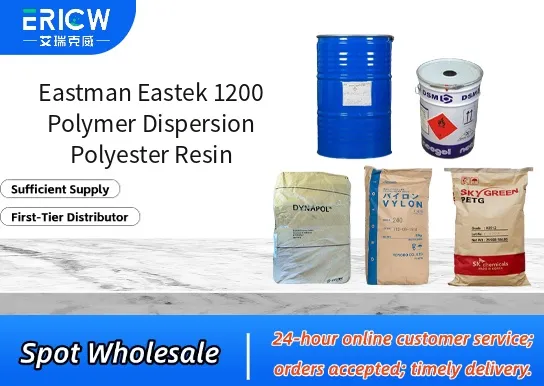
Water-based, non-ionic polyester dispersion offering excellent film formation without coalescent solvents.
Provides outstanding adhesion to metal, plastic, and primed substrates in ambient-cure coatings.
Delivers balanced hardness, flexibility, and chemical resistance for durable protective finishes.
Low VOC formulation compliant with stringent environmental regulations for industrial coatings.
Stable rheology and broad compatibility with acrylic dispersions, crosslinkers, and additives.
Industrial maintenance coatings for metal structures and equipment.
Coil coating topcoats requiring corrosion resistance and gloss retention.
Plastic substrate coatings for automotive interior trim and appliances.
Waterborne general-purpose protective coatings for architectural and OEM applications.
Basecoat formulations in two-component waterborne systems with amino or polyisocyanate crosslinkers.
| Chemical Type | Polyester polymer dispersion |
| Product Form | White to off-white aqueous dispersion |
| Appearance | Opaque liquid, homogeneous, no sediment |
| Solids Content (wt%) | 45–47% |
| pH | 7.5–8.5 |
| Viscosity (Brookfield RVT, #2 spindle, 20 rpm, 25°C) | 150–300 cP |
| Density (25°C) | 1.02–1.04 g/cm³ |
| Particle Size (D50) | 150–250 nm |
Q1: What is the primary function of Eastman Eastek 1200 in coating and ink formulations?
A: Eastek 1200 functions as a film-forming polymer dispersion that enhances adhesion, flexibility, and surface durability in waterborne systems. It is commonly used to improve substrate bonding—especially on low-surface-energy plastics—and contributes to cohesive strength without compromising colloidal stability.
Q2: Is Eastek 1200 compatible with common waterborne acrylic or vinyl acetate-based emulsions?
A: Yes, Eastek 1200 is formulated for compatibility with a broad range of waterborne polymer emulsions, including acrylics and vinyl acetate copolymers. Compatibility should be verified in the final formulation through standard stability testing—including freeze-thaw, high-shear mixing, and storage evaluation—due to sensitivity to pH and ionic environment.
Q3: How does Eastek 1200 contribute to improving scratch resistance in dried films?
A: The polyester backbone and dispersed particle morphology of Eastek 1200 promote inter-particle coalescence and microstructural reinforcement during film formation. This results in improved hardness and resistance to light abrasion, particularly when combined with appropriate crosslinkers or post-cure treatments.
Q4: Can Eastek 1200 be used in food-contact compliant coatings?
A: Eastek 1200 is not pre-approved for direct food-contact applications. Formulators seeking regulatory compliance must conduct full migration and toxicological assessments aligned with applicable regional requirements, and verify suitability through third-party testing of the final cured film.
Contact With Us:
E-mail: wangxingqiang@ericwchem.com
Have a Questions? Call Us:
Add:
Building A1, Jiete Industrial Park, Huangpu District, Guangzhou City, Guangdong Province, China