English
 Español
 tiếng việt
 русский
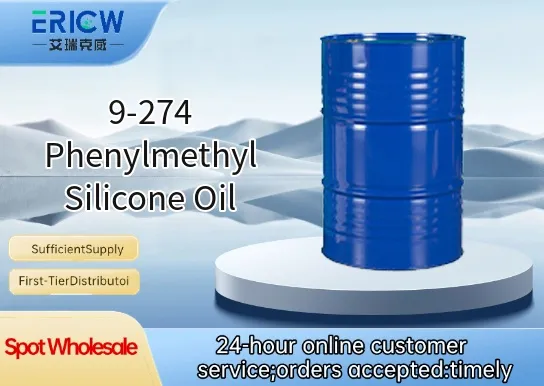
Excellent thermal stability up to 250 °C in inert atmospheres.
Superior oxidative resistance compared to standard methyl silicone oils.
Low volatility and high flash point for enhanced process safety.
Good compatibility with organic resins, fillers, and elastomers.
Clear, colorless to pale yellow liquid with low pour point (≤ −50 °C).
High-temperature heat transfer fluids in closed-loop industrial systems.
Base fluid for specialty lubricants used in aerospace and precision instrumentation.
Release agent for composite molding of carbon fiber and high-performance thermosets.
Dielectric coolant in high-voltage transformers and capacitors requiring extended service life.
Formulation component in high-stability silicone greases for extreme-temperature bearings.
| Chemical Type | Phenylmethyl polysiloxane |
| Product Form | Liquid |
| Appearance | Clear, colorless to pale yellow liquid |
| Viscosity (25 °C, cSt) | 1000 ± 150 |
| Density (25 °C, g/cm³) | 1.02–1.05 |
| Flash Point (COC, °C) | ≥ 310 |
| Pour Point (°C) | ≤ −50 |
| Volatile Matter (150 °C, 2 h, wt%) | ≤ 1.0 |
Q1: What distinguishes 9-274 Phenylmethyl Silicone Oil from standard dimethyl silicone oils?
A: 9-274 features phenyl groups substituted onto the siloxane backbone, which significantly enhances thermal stability, UV resistance, and compatibility with aromatic solvents and resins—making it especially suitable for high-performance coatings, optical applications, and demanding elastomer formulations where conventional methyl-based silicones may degrade or phase-separate.
Q2: Is 9-274 compatible with common polymer systems such as polyurethanes, epoxies, and acrylics?
A: Yes—its phenylmethyl structure imparts broad miscibility with many polar and non-polar resins. It is frequently used as a surface modifier or internal lubricant in polyurethane coatings and epoxy composites to improve flow, reduce surface tension, and minimize defects like craters or orange peel, without compromising cure kinetics or final film integrity.
Q3: How should 9-274 be incorporated into formulations to ensure optimal performance?
A: It is typically added during the late-stage mixing phase under mild shear and ambient to moderate temperatures. Due to its low volatility and good thermal stability, it remains well-dispersed without premature volatilization. Dosage depends on formulation requirements but generally ranges from 0.1% to 2% by weight—start with lower levels and adjust based on surface quality and mechanical property targets.
Q4: Can 9-274 be used in applications requiring FDA compliance or food-contact safety?
A: 9-274 is not pre-approved for direct food-contact applications under FDA 21 CFR or equivalent global food safety regulations. While certain phenylmethyl silicones may be evaluated for specific indirect contact uses, formal regulatory clearance requires case-by-case assessment—including full toxicological review and migration testing—by the end-user or formulator in accordance with applicable jurisdictional requirements.
Contact With Us:
E-mail: wangxingqiang@ericwchem.com
Have a Questions? Call Us:
Add:
Building A1, Jiete Industrial Park, Huangpu District, Guangzhou City, Guangdong Province, China