English
 Español
 tiếng việt
 русский
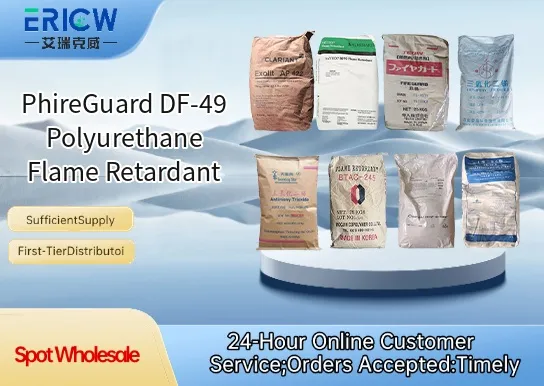
Halogen-free formulation ensures low smoke density and reduced toxic gas emission during combustion.
Excellent compatibility with flexible and rigid polyurethane foam systems without compromising physical properties.
Efficient char-forming mechanism enhances flame resistance while maintaining foam elasticity and cell structure.
Thermally stable up to 220 °C, supporting standard PU processing temperatures without premature decomposition.
Non-migrating design provides long-term flame-retardant performance and prevents surface blooming or leaching.
Flexible polyurethane foams for upholstered furniture meeting CAL TB 117-2013 and UK BS 5852 standards.
Rigid PU insulation boards used in building envelope applications requiring Euroclass B-s1,d0 classification.
Automotive seating and interior trim components complying with FMVSS 302 and ISO 3795.
Marine cushioning and bedding systems adhering to IMO FTP Code Part 5 fire safety requirements.
Commercial mattress cores and padding materials targeting GREENGUARD Gold and UL 1016 certification pathways.
| Chemical Type | Phosphorus-based intumescent additive |
| Product Form | Free-flowing white to off-white powder |
| Appearance | Homogeneous fine particulate solid |
| Density (25 °C) | 1.45–1.55 g/cm³ |
| Moisture Content | ≤ 0.5% w/w (by Karl Fischer titration) |
| pH (10% aqueous dispersion) | 6.5–7.5 |
| Onset Decomposition Temperature | ≥ 220 °C (TGA, 10 °C/min, air) |
| Recommended Loading Range | 12–18 phr in flexible PU foam; 15–22 phr in rigid PU foam |
Q1: What types of polyurethane systems is PhireGuard DF-49 compatible with?
A: PhireGuard DF-49 is formulated for use in both flexible and rigid polyurethane foams, including slabstock, molded, and spray-applied systems. It demonstrates good compatibility with common polyol blends and isosyanates used in conventional PU formulations.
Q2: How does PhireGuard DF-49 achieve flame retardancy without halogenated chemistry?
A: PhireGuard DF-49 operates primarily through an intumescent mechanism—promoting char formation and releasing non-combustible gases upon thermal exposure. Its phosphorus- and nitrogen-based structure supports condensed-phase activity, helping to reduce heat release and suppress flame spread in a halogen-free manner.
Q3: Does PhireGuard DF-49 affect foam processing or physical properties?
A: When incorporated at typical usage levels, PhireGuard DF-49 generally maintains acceptable cream time, rise profile, and demold characteristics. It may slightly influence compression set or tensile strength depending on the base formulation, so optimization trials are recommended for critical performance requirements.
Q4: What is the recommended dosage range for achieving standard fire performance targets?
A: Dosage depends on the specific PU system, density, and target fire classification (e.g., UL 94 HF-1, CAL 117). PhireGuard DF-49 is typically used at low concentrations—generally ranging from 0.1% to 2% by weight relative to total formulation—and is often combined with synergistic fillers or surface treatments for enhanced efficiency.
Contact With Us:
E-mail: wangxingqiang@ericwchem.com
Have a Questions? Call Us:
Add:
Building A1, Jiete Industrial Park, Huangpu District, Guangzhou City, Guangdong Province, China