English
 Español
 tiếng việt
 русский
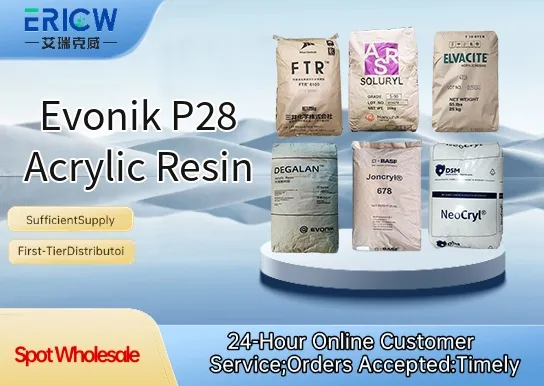
High solids content for reduced VOC emissions and improved coating efficiency.
Excellent UV resistance and long-term gloss retention in exterior applications.
Good compatibility with common crosslinkers including melamine and polyisocyanates.
Low viscosity at high solids, enabling easy formulation and spray application.
Superior hydrolytic stability compared to conventional acrylic resins.
Automotive OEM clearcoats and basecoats.
Industrial maintenance coatings for metal and plastic substrates.
High-performance coil coatings requiring weatherability and flexibility.
Powder coating hybrid systems (acrylic-polyester blends).
Architectural coatings for façade and roofing membranes.
| Chemical Type | Thermosetting acrylic copolymer |
| Product Form | Liquid resin solution |
| Appearance | Clear, pale yellow liquid |
| Solids Content | 60 ± 2 wt% |
| Non-Volatile Content | 60 ± 2 wt% |
| Viscosity (25°C) | 1,200–1,800 mPa·s (Brookfield, spindle #3, 60 rpm) |
| Acid Value | 8–12 mg KOH/g |
| Hydroxyl Value | 95–105 mg KOH/g |
Q1: What is the primary function of Evonik P28 Acrylic Resin in coating and ink formulations?
A: Evonik P28 is a specialty acrylic resin designed primarily as a rheology modifier and matting agent. It helps control viscosity, improve suspension stability, and deliver consistent, uniform matte finishes without significantly compromising film clarity or gloss uniformity.
Q2: Is P28 compatible with both solvent-based and water-based systems?
A: Yes — P28 exhibits broad compatibility across solvent-borne, high-solids, and aqueous systems. Its performance may vary depending on pH, ionic strength, and co-dispersants used in water-based applications, so formulation optimization is recommended.
Q3: How should P28 be incorporated into a formulation to ensure optimal dispersion and performance?
A: P28 is typically added during the pigment grinding or let-down stage using high-shear mixing. Pre-wetting with a portion of the carrier solvent or water prior to incorporation enhances dispersion efficiency and minimizes agglomeration.
Q4: Does P28 contribute to film hardness or scratch resistance in finished coatings?
A: While not a primary film-former, P28 can positively influence surface mechanical properties due to its particle morphology and interfacial interactions. Enhanced hardness and improved mar resistance are often observed at appropriate dosage levels, especially in combination with crosslinking resins.
Contact With Us:
E-mail: wangxingqiang@ericwchem.com
Have a Questions? Call Us:
Add:
Building A1, Jiete Industrial Park, Huangpu District, Guangzhou City, Guangdong Province, China