English
 Español
 tiếng việt
 русский
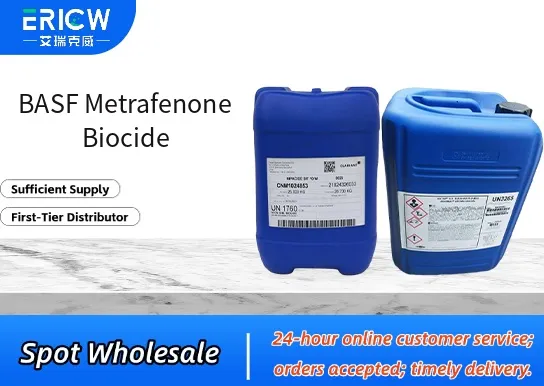
Highly effective against a broad spectrum of fungi, including powdery mildew pathogens.
Systemic and protective activity with translaminar movement in plant tissues.
Low mammalian toxicity and favorable environmental profile for sustainable agriculture.
Compatible with integrated pest management (IPM) programs and resistance management strategies.
Stable under field conditions with reliable rainfastness and UV tolerance.
Vineyards – control of grapevine powdery mildew (Erysiphe necator).
Fruit orchards – management of powdery mildew on apple, pear, and stone fruits.
Vegetable production – suppression of cucurbit and solanaceous powdery mildew species.
Field crops – targeted use in hop cultivation for downy and powdery mildew control.
Protected horticulture – greenhouse applications on ornamentals and high-value vegetables.
| Chemical Type | Triazolinone fungicide |
| Active Ingredient | Metrafenone (CAS No. 136290-00-7) |
| Product Form | SC (Suspension Concentrate) |
| Appearance | Off-white to pale yellow suspension |
| Primary Applications | Fungicidal control of Erysiphales (powdery mildews) |
| Key Features | Translaminar mobility, anti-resistance properties, low volatility |
| Benefits | Flexible application timing, residual protection, compatibility with most adjuvants |
| Storage Stability | Stable for ≥24 months at 5–25°C in original sealed container |
Q1: What is the primary mode of action of Metrafenone in biocidal applications?
A: Metrafenone functions as a highly selective, contact-acting fungicide with systemic properties, primarily inhibiting fungal cell wall synthesis and disrupting hyphal growth. Its efficacy is particularly pronounced against powdery mildew pathogens in agricultural and industrial settings.
Q2: In which types of industrial formulations is BASF Metrafenone Biocide commonly incorporated?
A: It is widely used in water-based industrial coatings, architectural paints, adhesives, sealants, and construction materials where long-term protection against mold, mildew, and filamentous fungi is required. Compatibility with common polymer systems and low volatility support its use in both interior and exterior applications.
Q3: How stable is Metrafenone under typical storage and processing conditions?
A: Metrafenone exhibits good thermal and hydrolytic stability across a broad pH range (approximately pH 4–9) and remains effective during standard formulation processes such as grinding, homogenization, and ambient-temperature storage. Long-term stability in finished products depends on overall formulation composition and packaging integrity.
Q4: Is BASF Metrafenone Biocide suitable for use in products intended for sensitive environments, such as schools or healthcare facilities?
A: Yes — when formulated at appropriate concentrations and applied according to regulatory guidelines and label directions, it delivers reliable antimicrobial performance with favorable toxicological and environmental profiles for indoor use. Formulators should always verify compliance with local biocidal product regulations and emission standards.
Contact With Us:
E-mail: wangxingqiang@ericwchem.com
Have a Questions? Call Us:
Add:
Building A1, Jiete Industrial Park, Huangpu District, Guangzhou City, Guangdong Province, China