English
 Español
 tiếng việt
 русский
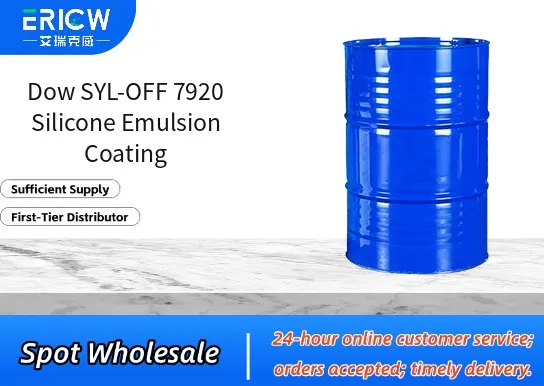
Non-ionic silicone emulsion offering excellent compatibility with water-based systems.
Provides durable, low-surface-energy release performance on coated substrates.
Enables smooth film formation without compromising substrate adhesion of subsequent layers.
Low VOC and APEO-free formulation supporting sustainable manufacturing practices.
Stable under typical processing conditions including moderate shear and pH range 5–9.
Release coatings for pressure-sensitive adhesive (PSA) liners.
Surface treatment for paper, film, and foil substrates in packaging applications.
Functional additive in water-based inks and coatings to enhance slip and mar resistance.
Component in textile finishing formulations for soft handle and hydrophobicity.
Coating for medical device release liners requiring biocompatibility support.
| Chemical Type | Methyl-phenyl modified polydimethylsiloxane emulsion |
| Product Form | Water-based anionic-stabilized emulsion |
| Appearance | Opaque white liquid |
| Solids Content | 30 ± 1 wt% |
| pH (at 25°C) | 6.5 – 7.5 |
| Viscosity (mPa·s, Brookfield DV-II, Spindle #3, 20 rpm) | 200 – 600 |
| Density (g/cm³, at 25°C) | 0.98 – 1.02 |
| Freeze-Thaw Stability | Passes 3-cycle test (–10°C/24 h → 25°C/24 h) |
Q1: What is the primary function of Dow SYL-OFF 7920 in coating formulations?
A: Dow SYL-OFF 7920 is a silicone emulsion designed to provide surface modification functionality—primarily enhancing slip, leveling, and substrate release properties in water-based coatings and inks. It acts as a processing aid and performance enhancer rather than a primary film-former.
Q2: Is Dow SYL-OFF 7920 compatible with acrylic, styrene-acrylic, and polyurethane dispersions?
A: Yes, SYL-OFF 7920 is formulated for broad compatibility with common waterborne polymer systems, including acrylics, styrene-acrylics, and aliphatic polyurethane dispersions. Compatibility should always be verified in the final formulation under intended processing and storage conditions.
Q3: How should Dow SYL-OFF 7920 be incorporated into a coating batch?
A: It is typically added during the let-down stage, after the main resin and pigments have been dispersed and stabilized. Gentle mixing is recommended to avoid excessive shear or air entrapment. Pre-dilution with water may improve uniform distribution in sensitive systems.
Q4: Does SYL-OFF 7920 require post-application curing or thermal activation to develop its full performance?
A: No—its surface-active silicone components migrate and orient during ambient drying or standard low-temperature coalescence. Performance benefits such as slip and release are generally realized without requiring elevated cure temperatures or additional crosslinking steps.
Q5: Can SYL-OFF 7920 be used in food-contact coating applications?
A: While SYL-OFF 7920 is based on non-ionic silicone chemistry commonly used in indirect food-contact coatings, its suitability for any specific food-contact application depends on full regulatory assessment—including end-use conditions, substrate type, and compliance with applicable regional requirements. Formulators must conduct their own due diligence and obtain appropriate regulatory guidance.
Contact With Us:
E-mail: wangxingqiang@ericwchem.com
Have a Questions? Call Us:
Add:
Building A1, Jiete Industrial Park, Huangpu District, Guangzhou City, Guangdong Province, China