English
 Español
 tiếng việt
 русский
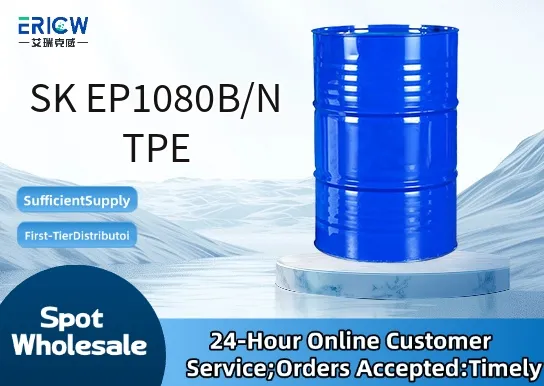
Excellent soft-touch feel with balanced elasticity and recovery.
Good processability via injection molding and extrusion without pre-drying.
Enhanced resistance to UV degradation and thermal aging.
Low extractables and compliant with ISO 10993 for biocompatibility-relevant applications.
Compatible with polypropylene (PP) and polyethylene (PE) for co-molding and overmolding.
Automotive interior trim components including door panels and instrument bezels.
Consumer electronics housings and protective grips for handheld devices.
Medical device grips and non-invasive wearable housing parts.
Household appliance seals, knobs, and ergonomic control surfaces.
Personal care product casings such as toothbrush handles and grooming tool grips.
| Chemical Type | Thermoplastic Elastomer (TPE) — Styrenic Block Copolymer (SBC) based |
| Product Form | Pellets |
| Appearance | Off-white translucent granules |
| Hardness (Shore A) | 80 ± 3 |
| Melt Flow Rate (230°C/2.16 kg) | 15–20 g/10 min |
| Density | 0.98–1.01 g/cm³ |
| Tensile Strength (ASTM D412) | 12–15 MPa |
| Elongation at Break (ASTM D412) | 450–550 % |
Q1: What is the primary function of SK EP1080B/N TPE in thermoplastic elastomer formulations?
A: SK EP1080B/N TPE is a specialized processing aid and compatibilizer designed to enhance melt flow, improve dispersion of fillers or additives, and support phase adhesion in multi-component TPE systems—particularly in SEBS- or TPO-based blends.
Q2: Is SK EP1080B/N TPE suitable for food-contact or medical-grade TPE applications?
A: While SK EP1080B/N TPE is formulated for high-purity performance and low volatility, its suitability for regulated applications depends on final formulation validation. It is not pre-certified for food or medical use; end-users must conduct full regulatory compliance testing per applicable jurisdictional requirements.
Q3: How does SK EP1080B/N TPE affect thermal stability during extrusion or injection molding?
A: SK EP1080B/N TPE exhibits good thermal stability under typical TPE processing conditions (up to approximately 230°C). It helps reduce shear heating effects and may contribute to more consistent melt viscosity—supporting stable output and reduced die buildup in continuous operations.
Q4: Can SK EP1080B/N TPE be used in combination with other polymer modifiers or plasticizers?
A: Yes—it is compatible with common TPE base polymers (e.g., SEBS, SBS, TPO) and can be co-used with non-reactive plasticizers, reinforcing fillers, and UV stabilizers. Compatibility with reactive additives should be verified through small-scale trials due to potential interaction effects.
Contact With Us:
E-mail: wangxingqiang@ericwchem.com
Have a Questions? Call Us:
Add:
Building A1, Jiete Industrial Park, Huangpu District, Guangzhou City, Guangdong Province, China