English
 Español
 tiếng việt
 русский
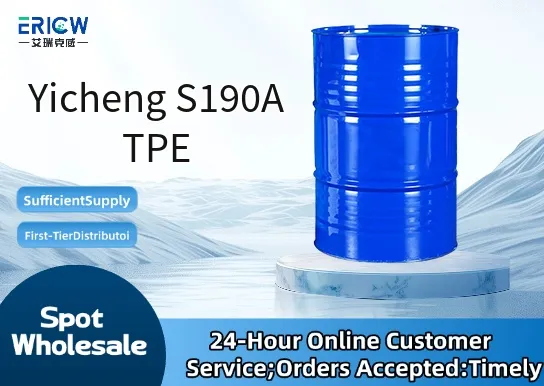
Excellent soft-touch feel with Shore A hardness of 90 ± 3, ideal for ergonomic overmolding.
Good adhesion to polypropylene (PP) and polyethylene (PE) without primer or surface treatment.
High elasticity and recovery performance, maintaining shape integrity after repeated flexing.
RoHS-compliant formulation with no phthalates, heavy metals, or halogenated flame retardants.
Easy processing via standard injection molding and extrusion equipment at temperatures of 160–190°C.
Soft-grip overmolded handles for power tools and garden equipment.
Sealing rings and gaskets in automotive fluid systems.
Consumer electronics casings and protective bumpers for handheld devices.
Medical device components requiring skin-contact compatibility and sterilization readiness (e.g., non-invasive housings).
| Chemical Type | Thermoplastic Elastomer (TPE), SEBS-based |
| Product Form | Natural color granules, free-flowing, 3–5 mm cylindrical pellets |
| Appearance | Opaque off-white to light beige, uniform particle size |
| Shore A Hardness | 90 ± 3 |
| Melt Flow Rate (190°C/2.16 kg) | 12–18 g/10 min |
| Density | 0.90–0.92 g/cm³ |
| Continuous Use Temperature | −40°C to +70°C |
| Primary Applications | Overmolding, sealing, soft-touch components |
Q1: What is the primary application domain for Yicheng S190A TPE?
A: Yicheng S190A TPE is primarily formulated for soft-touch overmolding and functional elastomeric components in consumer electronics, personal care devices, and precision hand tools—where consistent melt flow, excellent adhesion to rigid thermoplastics (e.g., ABS, PC, PP), and tactile performance are critical.
Q2: Is Yicheng S190A TPE suitable for food-contact or skin-contact applications?
A: Yicheng S190A TPE is designed with non-toxic, low-extractable raw materials and complies with general regulatory expectations for skin-contact applications. For food-contact use, final compliance depends on the complete formulation, processing conditions, and applicable regional requirements—customers should conduct full regulatory validation in their intended application context.
Q3: How does Yicheng S190A TPE perform in terms of thermal stability during processing?
A: Yicheng S190A TPE exhibits good thermal stability under standard injection molding and extrusion conditions. It maintains consistent rheology and minimal degradation when processed within its recommended temperature window, supporting stable production runs and reproducible part quality without excessive volatiles or discoloration.
Q4: Can Yicheng S190A TPE be recycled or reprocessed?
A: Yes—Yicheng S190A TPE is fully thermoplastic and compatible with mechanical recycling. Regrind from clean, uncontaminated production scrap can typically be reintroduced at moderate levels without significant loss of key mechanical or aesthetic properties, though optimal regrind ratio should be verified per specific process and part requirements.
Contact With Us:
E-mail: wangxingqiang@ericwchem.com
Have a Questions? Call Us:
Add:
Building A1, Jiete Industrial Park, Huangpu District, Guangzhou City, Guangdong Province, China