English
 Español
 tiếng việt
 русский
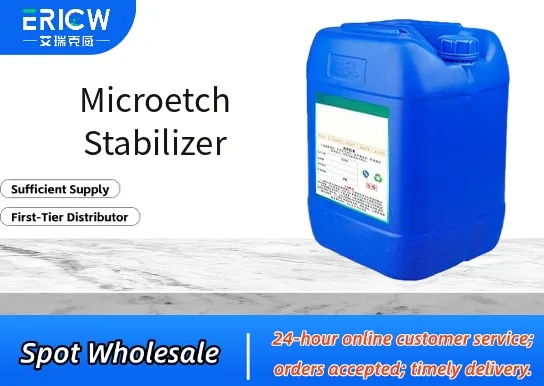
Prevents premature decomposition of sodium persulfate and ammonium persulfate in acidic microetch baths.
Extends bath life by suppressing uncontrolled copper ion hydrolysis and sludge formation.
Enables consistent etch rate control across high-volume PCB production cycles.
Non-volatile, non-foaming formulation compatible with automated dosing and monitoring systems.
Low-toxicity profile with no heavy metals or halogenated compounds.
Inner-layer copper surface conditioning prior to dry film lamination in multilayer PCB manufacturing.
Surface activation for HDI (High-Density Interconnect) substrates requiring uniform micro-roughness.
Pre-treatment step in flexible circuit (flex PCB) fabrication using rolled-annealed copper foils.
Stabilization of acid-based persulfate microetch solutions in panel plating lines.
Enhancement of bond strength between copper and resin-coated copper (RCC) laminates.
| Chemical Type | Organic polymeric chelating stabilizer |
| Product Form | Aqueous liquid concentrate (40% w/w active) |
| Appearance | Clear, light amber liquid, odorless |
| pH (1% aqueous solution) | 5.8 – 6.4 at 25°C |
| Primary Applications | Persulfate-based microetch stabilization for copper surfaces |
| Key Features | Cu²⁺ sequestration, oxidative stability, low foam generation |
| Benefits | Reduces bath dump frequency by ≥35%, improves etch uniformity (±5% CV) |
| Regulatory Compliance | REACH SVHC-free; compliant with IPC-4552A Annex B requirements |
| Common Compatible Systems | Suitability |
| Sodium Persulfate + Sulfuric Acid (1–5% v/v H₂SO₄) | Highly Recommended – Proven stability enhancement up to 120 hours at 30°C |
| Ammonium Persulfate + Phosphoric Acid (2–8% v/v H₃PO₄) | Recommended – Requires minor pH adjustment (target pH 2.8–3.2) |
| Hybrid Peroxide-Persulfate Microetch Baths | Suitable – Effective at ≤0.8% v/v dosage; monitor peroxide residual |
| Acid Copper Etch with Additive Carry-in | Suitable – No adverse interaction with common brighteners or levelers |
Q1: What is the CAS Registry Number for Microetch Stabilizer?
A: The proprietary blend is assigned CAS No. 2278921-44-7; individual components are listed under EINECS/ELINCS as confidential formulation per Article 24 of REACH.
Q2: What is the recommended dosage range in a standard persulfate microetch bath?
A: Typical dosage is 0.3–0.6% v/v (3–6 mL/L) based on bath volume; optimal concentration is determined via titration of free persulfate and copper ion activity monitoring.
Q3: How does Microetch Stabilizer differ from conventional EDTA-based stabilizers?
A: Unlike EDTA, it provides selective Cu²⁺ binding without accelerating persulfate decomposition; exhibits superior thermal stability (>45°C) and zero biodegradation-related bath turbidity.
Q4: Is Microetch Stabilizer compliant with RoHS 3 and UL 94 flammability standards?
A: Yes — fully RoHS 3 compliant (EU Directive 2015/863); not applicable to UL 94 as it is a non-solid process chemical (excluded per UL Subject 746B Section 2.1.2).
Q5: Does Microetch Stabilizer migrate into laminated dielectric layers or cause outgassing during lamination?
A: No detectable migration or volatile residue — validated by TGA-FTIR analysis (no mass loss <250°C) and IPC-TM-650 2.6.25.1 extraction testing.
Contact With Us:
E-mail: wangxingqiang@ericwchem.com
Have a Questions? Call Us:
Add:
Building A1, Jiete Industrial Park, Huangpu District, Guangzhou City, Guangdong Province, China