English
 Español
 tiếng việt
 русский
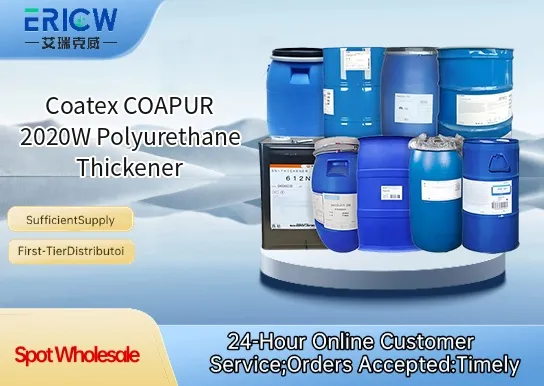
Non-ionic, hydrophobically modified polyurethane (HEUR) rheology modifier.
Delivers excellent mid-shear viscosity build and outstanding sag resistance in waterborne systems.
Compatible with a broad range of anionic and non-ionic surfactants, co-thickeners, and biocides.
Provides low foaming characteristics and good spatter resistance during application.
Enables efficient viscosity control with minimal dosage and excellent storage stability.
Architectural interior and exterior latex paints.
Waterborne industrial maintenance coatings.
Decorative wall coatings and textured finishes.
Water-based primers and undercoats.
Low-VOC and zero-VOC coating formulations.
| Chemical Type | Hydrophobically Modified Polyurethane (HEUR) |
| Product Form | Liquid dispersion |
| Appearance | Opaque white to off-white liquid |
| pH (1% aqueous solution) | 7.0 – 8.5 |
| Active Content | 20.0 ± 1.0 wt% |
| Viscosity (25°C, Brookfield RVT, spindle #3, 20 rpm) | 1,500 – 4,000 mPa·s |
| Freeze-Thaw Stability | Pass (3 cycles at –5°C / 23°C) |
| Primary Applications | Waterborne architectural and industrial coatings |
Q1: What type of rheology does COAPUR 2020W provide in waterborne systems?
A: COAPUR 2020W is a non-ionic polyurethane associative thickener that delivers pronounced pseudoplastic (shear-thinning) behavior, supporting excellent sag resistance at rest while enabling good flow and leveling during application.
Q2: Is COAPUR 2020W compatible with common co-thickeners or rheology modifiers?
A: Yes — it is frequently used in combination with cellulosic thickeners or acrylic associates to fine-tune rheological profiles. However, compatibility testing is recommended when blending with cationic additives or high-solids associative thickeners to avoid destabilization.
Q3: How should COAPUR 2020W be incorporated into a formulation?
A: It is typically added during the let-down stage under moderate agitation. Pre-dilution with water or co-solvent may improve dispersion. Avoid high-shear addition directly to highly ionic or low-pH phases without prior stabilization.
Q4: Does COAPUR 2020W offer resistance to microbial degradation?
A: As a synthetic polyurethane polymer, it does not serve as a nutrient source for microorganisms and exhibits inherent stability against biological degradation — unlike some natural or modified-cellulose thickeners.
Contact With Us:
E-mail: wangxingqiang@ericwchem.com
Have a Questions? Call Us:
Add:
Building A1, Jiete Industrial Park, Huangpu District, Guangzhou City, Guangdong Province, China