English
 Español
 tiếng việt
 русский
Highly selective hydrogenation catalyst for unsaturated aldehydes and ketones.
Exceptional thermal and chemical stability under continuous fixed-bed operation.
Low noble metal loading optimized for cost-effective, long-cycle performance.
Controlled pore structure enabling superior mass transfer and reduced coking tendency.
Designed for easy integration into existing hydrotreating units without major retrofitting.
Selective hydrogenation of crotonaldehyde to butyraldehyde in C4 chemistry.
Production of saturated alcohols from α,β-unsaturated carbonyl compounds.
Upgrading bio-based feedstocks containing reactive oxygenates.
Refining of intermediate streams in fine chemical synthesis.
Hydrogenation step in pharmaceutical and agrochemical active ingredient manufacturing.
| Chemical Type | Supported palladium-based heterogeneous catalyst |
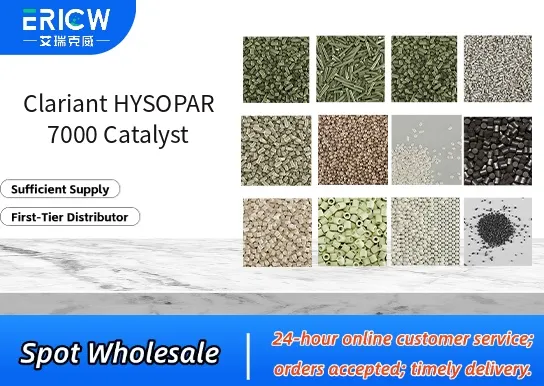
| Product Form | Extruded cylindrical pellets (3 mm diameter) |
| Appearance | Gray-black free-flowing solid |
| Primary Applications | Selective liquid-phase hydrogenation of α,β-unsaturated aldehydes/ketones |
| Key Features | High chemoselectivity, low methane formation, robust sulfur tolerance |
| Benefits | Extended catalyst life, reduced downstream purification, improved product purity |
| Storage Conditions | Store in original sealed container under inert atmosphere at ambient temperature |
| Handling Precautions | Use in well-ventilated area; avoid contact with strong oxidizers or halogenated compounds |
Q1: What is the primary function of HYSOPAR 7000 in polymer processing?
A: HYSOPAR 7000 is a heterogeneous hydrogenation catalyst designed to selectively saturate unsaturated bonds—particularly residual dienes and alkenes—in synthetic rubber and thermoplastic elastomer streams during continuous or batch post-polymerization processing.
Q2: Is HYSOPAR 7000 compatible with common elastomer systems such as SBR, BR, and solution-polymerized styrenic thermoplastic elastomers?
A: Yes, HYSOPAR 7000 has demonstrated robust compatibility and activity in solution- and emulsion-based elastomer systems, including styrene–butadiene rubber (SBR), polybutadiene rubber (BR), and styrenic block copolymers (e.g., SBS, SEBS). Performance may vary depending on solvent polarity, temperature profile, and feedstock impurity levels.
Q3: How is HYSOPAR 7000 typically introduced into the process stream?
A: It is generally introduced as a slurry in a compatible hydrocarbon carrier or directly metered into the polymer solution prior to hydrogenation reactors. The catalyst is designed for ease of handling and dispersion under standard industrial mixing conditions.
Q4: Does HYSOPAR 7000 require special activation or pre-treatment before use?
A: No pre-activation is required. HYSOPAR 7000 is supplied in a ready-to-use form and becomes active upon exposure to hydrogen gas under typical reaction conditions (moderate temperatures and pressures). Standard inert-atmosphere handling is recommended to maintain shelf stability.
Q5: What are key storage and handling recommendations?
A: Store in original sealed containers under dry, inert atmosphere at ambient temperature. Avoid prolonged exposure to moisture, air, or strong oxidizing agents. Use appropriate personal protective equipment (PPE) when handling, as with any fine metal-containing powder.
Contact With Us:
E-mail: wangxingqiang@ericwchem.com
Have a Questions? Call Us:
Add:
Building A1, Jiete Industrial Park, Huangpu District, Guangzhou City, Guangdong Province, China