English
 Español
 tiếng việt
 русский
High reactivity with standard peroxide initiators for rapid gelation and efficient production cycles.
Excellent mechanical strength and dimensional stability in cured composites.
Good compatibility with common glass fiber reinforcements and fillers.
Low viscosity enabling superior wet-out of reinforcement materials and ease of processing.
Consistent batch-to-batch performance supported by Evonik’s stringent quality control.
Fiberglass-reinforced plastic (FRP) tanks and vessels for chemical storage.
Marine components including boat hulls, decks, and structural panels.
Industrial grating, ducting, and corrosion-resistant linings.
Automotive under-hood parts requiring thermal and chemical resistance.
Wind energy blade subcomponents and structural housings.
| Chemical Type | Unsaturated orthophthalic polyester resin |
| Product Form | Liquid |
| Appearance | Clear to pale yellow, homogeneous liquid |
| Viscosity (25 °C, mPa·s) | 350–450 |
| Reactive Diluent | Styrene (~38–42 wt%) |
| Gel Time (with 1.0% MEKP, 25 °C, min) | 12–18 |
| Acid Value (mg KOH/g) | 16–22 |
| Density (25 °C, g/cm³) | 1.11–1.13 |
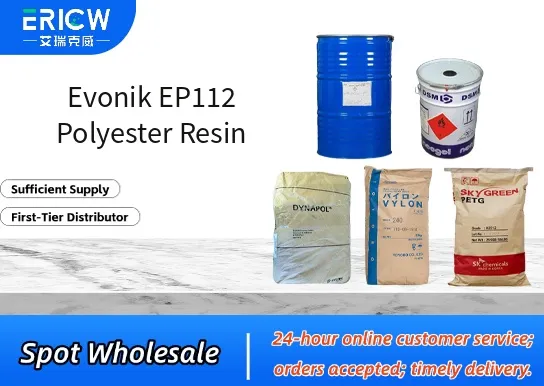
Q1: What is the primary function of EP112 in polyester resin systems?
A: EP112 is a reactive liquid modifier designed to enhance flexibility, impact resistance, and adhesion in unsaturated polyester resins without significantly compromising cure speed or surface hardness.
Q2: Is EP112 compatible with standard styrene-based polyester formulations?
A: Yes, EP112 exhibits excellent miscibility with conventional styrenated unsaturated polyesters and can be incorporated directly into the resin phase prior to catalyst addition, without requiring solvent dilution or pre-reaction.
Q3: How does EP112 affect the gel time and post-cure properties of cured laminates?
A: At typical use levels, EP112 causes only minor extension of gel time and does not hinder full crosslink development; cured composites retain good thermal stability and retain mechanical integrity after post-curing.
Q4: Can EP112 be used in gel coat applications?
A: Yes — EP112 is suitable for gel coat formulations where improved crack resistance and substrate adhesion are required, particularly on flexible or thermally stressed substrates, while maintaining acceptable surface finish and sandability.
Contact With Us:
E-mail: wangxingqiang@ericwchem.com
Have a Questions? Call Us:
Add:
Building A1, Jiete Industrial Park, Huangpu District, Guangzhou City, Guangdong Province, China