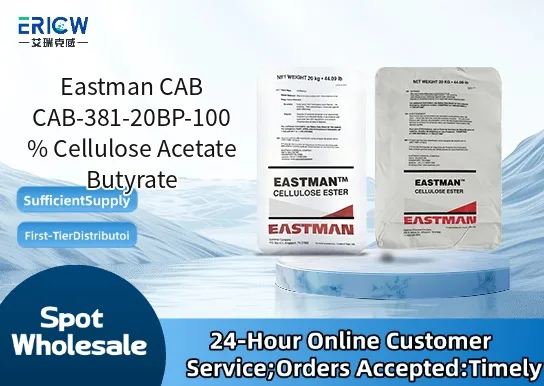
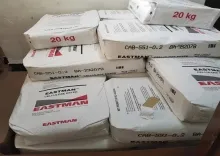
Features Of Eastman CAB CAB-381-20BP-100% Cellulose Acetate Butyrate
Excellent solubility in a broad range of common organic solvents, including esters, ketones, and aromatic hydrocarbons.
Superior film-forming capability with high clarity, gloss, and toughness for demanding coating applications.
Outstanding resistance to moisture, UV radiation, and plasticizer migration compared to standard cellulose acetate.
Good compatibility with nitrocellulose, acrylics, polyurethanes, and many plasticizers for versatile formulation design.
Low solution viscosity at high solids content, enabling efficient application and reduced solvent usage.
Typical Applications Of Eastman CAB CAB-381-20BP-100% Cellulose Acetate Butyrate
Automotive clearcoats and basecoat additives for enhanced mar resistance and flow control.
Industrial maintenance coatings requiring durability, chemical resistance, and rapid drying.
Wood furniture finishes where clarity, hardness, and sandability are critical performance criteria.
Flexible packaging inks and overprint varnishes demanding excellent substrate adhesion and gloss retention.
Adhesive modifiers for pressure-sensitive and laminating adhesives to improve tack and shear strength.
Specifications Of Eastman CAB CAB-381-20BP-100% Cellulose Acetate Butyrate
| Chemical Type | Cellulose acetate butyrate (CAB) |
| Product Form | Free-flowing white to off-white granular solid |
| Appearance | White to light tan granules |
| Butyryl Content (wt%) | 20–22% |
| Acetyl Content (wt%) | ~38% |
| Hydroxyl Content (wt%) | ~2.5% |
| Typical Intrinsic Viscosity (dL/g, 0.5% in acetone) | 1.0–1.2 |
| Moisture Content (max) | 1.0% |
Eastman CAB CAB-381-20BP-100% Cellulose Acetate Butyrate – Frequently Asked Questions (FAQ)
Q1: What are the key performance advantages of CAB-381-20BP compared to other cellulose esters?
A: CAB-381-20BP offers an excellent balance of solubility in a broad range of common organic solvents—including ketones, esters, and some alcohols—along with good film-forming capability, low moisture absorption, and enhanced compatibility with many resins and plasticizers. Its butyryl content contributes to improved flexibility and reduced brittleness relative to standard cellulose acetates.
Q2: Is CAB-381-20BP suitable for use in coatings requiring fast drying and high gloss?
A: Yes—its relatively low solution viscosity and favorable evaporation profile support rapid solvent release and smooth film formation, making it well-suited for high-gloss, quick-drying industrial and specialty coatings, including overprint varnishes and ink vehicle systems.
Q3: How does CAB-381-20BP perform in formulations exposed to UV light or outdoor weathering?
A: While not inherently UV-stabilized, CAB-381-20BP exhibits better inherent resistance to yellowing and degradation under UV exposure than many traditional cellulose acetates due to its butyryl substitution. For extended outdoor applications, it is typically used in combination with appropriate UV absorbers or HALS stabilizers.
Q4: Can CAB-381-20BP be blended with other film-forming resins?
A: Yes—it demonstrates good compatibility with a wide variety of resins, including acrylics, polyvinyl butyral (PVB), nitrocellulose, and certain alkyds, enabling formulators to tailor hardness, flexibility, adhesion, and chemical resistance without phase separation in properly designed solvent systems.
Q5: What handling precautions should be observed during processing?
A: As with most organic-soluble thermoplastic resins, standard industrial hygiene practices apply: ensure adequate ventilation during dissolution and processing, avoid inhalation of dust or solvent vapors, and consult the Safety Data Sheet (SDS) for specific guidance on personal protective equipment and safe storage conditions.
 English
 Español
 tiếng việt
 русский