English
 Español
 tiếng việt
 русский
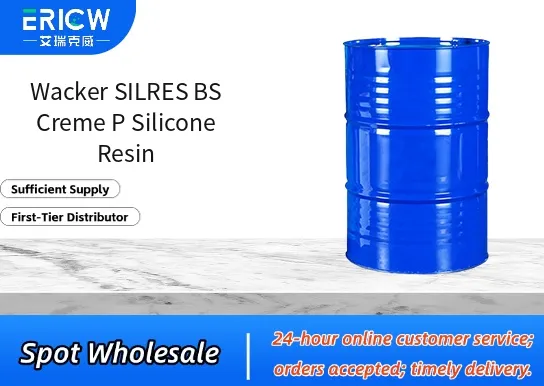
High-solids, solvent-based silicone resin dispersion with excellent storage stability.
Delivers outstanding water repellency and breathability on mineral substrates.
Enables formulation of low-VOC, high-performance protective coatings for façades and masonry.
Exhibits excellent compatibility with acrylic, silicate, and siloxane-based binder systems.
Provides enhanced resistance to UV radiation, alkali, and weathering without yellowing.
Water-repellent impregnation for concrete, brick, and natural stone façades.
Key additive in mineral-based renders and plasters for exterior insulation systems (ETICS).
Performance enhancer in silicate paints and facade coatings requiring long-term durability.
Functional ingredient in breathable, hydrophobic primers for renovation and restoration projects.
Component in high-end architectural coatings where efflorescence resistance and vapor permeability are critical.
| Chemical Type | Alkyl-modified silicone resin dispersion |
| Product Form | Liquid dispersion |
| Appearance | White to slightly opalescent liquid |
| Solvent System | Aromatic-free hydrocarbon solvents |
| Solids Content | Approx. 45–48 wt.% |
| pH (1% aqueous dilution) | 6.0–7.5 |
| Viscosity (20°C, Brookfield RVT, spindle #3, 20 rpm) | 1,500–3,500 mPa·s |
| Storage Stability (25°C) | ≥ 12 months in unopened original container |
Q1: What is the primary function of SILRES BS Creme P in coating and paint formulations?
A: SILRES BS Creme P is a water-dispersible silicone resin designed to enhance surface properties—particularly water repellency, substrate wetting, and resistance to dirt pickup—without compromising film formation or gloss. It functions as a performance additive rather than a binder, and is typically incorporated into acrylic, styrene-acrylic, or silicate-based systems.
Q2: Is SILRES BS Creme P compatible with standard architectural coating ingredients such as thickeners, dispersants, and biocides?
A: Yes, SILRES BS Creme P demonstrates good compatibility with common formulation additives, including associative and non-associative rheology modifiers, anionic and non-ionic dispersants, and typical isothiazolinone- or benzisothiazole-based preservatives. Compatibility testing under actual formulation conditions is recommended to confirm stability and performance.
Q3: How should SILRES BS Creme P be incorporated into a waterborne system?
A: It is generally added during the let-down stage, after pigment grinding and before final adjustment of viscosity and pH. Due to its low viscosity and stable dispersion, it can be introduced directly without pre-dilution, though gentle mixing is advised to avoid air entrapment. Avoid high-shear addition at very low pH (<7) or in strongly alkaline media (>pH 10) to maintain long-term colloidal stability.
Q4: Does SILRES BS Creme P contribute to film hydrophobicity while maintaining breathability?
A: Yes—its silicone resin structure imparts durable water repellency at the surface without forming a continuous impermeable barrier. This allows moisture vapor transmission (MVT) to remain largely unaffected, supporting its use in breathable façade coatings and mineral plasters where condensation control is critical.
Contact With Us:
E-mail: wangxingqiang@ericwchem.com
Have a Questions? Call Us:
Add:
Building A1, Jiete Industrial Park, Huangpu District, Guangzhou City, Guangdong Province, China