English
 Español
 tiếng việt
 русский
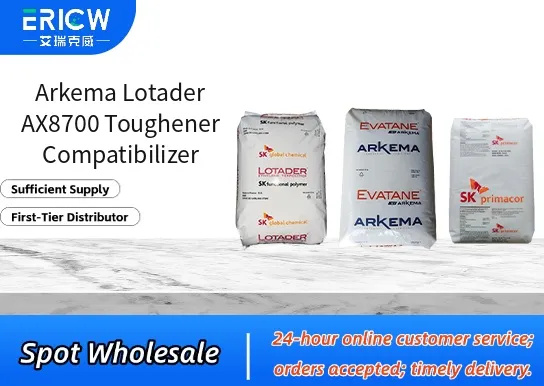
Enhanced impact resistance in polyolefin-based blends without compromising stiffness.
Effective compatibilization between non-polar polyolefins (e.g., PP, PE) and polar polymers or fillers (e.g., PA, EVOH, glass fiber).
Low-melt-viscosity grade enabling excellent processability in extrusion and injection molding.
Functionalized with glycidyl methacrylate (GMA), providing reactive anchoring sites for covalent bond formation at interfaces.
Improved interfacial adhesion leading to superior tensile strength and elongation at break in multiphase systems.
Automotive interior and exterior components (e.g., bumpers, dashboards, door panels).
Packaging multilayer films requiring high barrier performance and toughness (e.g., PP/PA/EVOH structures).
Engineering plastic compounds for industrial parts subjected to mechanical stress and thermal cycling.
Recycled polyolefin upcycling—improving compatibility and mechanical properties of post-consumer PP/PE blends.
Overmolding applications where PP substrates are bonded to polar thermoplastic elastomers or rigid engineering resins.
| Chemical Type | Glycidyl methacrylate (GMA)-grafted ethylene–butene copolymer |
| Product Form | Pellets |
| Appearance | Off-white to light yellow free-flowing pellets |
| Primary Applications | Polyolefin toughening & compatibilization in blends with polyamides, polyesters, and polar fillers |
| Key Features | GMA functionality (~1.0–1.3 wt%), low crystallinity, medium molecular weight |
| Benefits | Improved melt flow, enhanced interfacial adhesion, reduced phase separation in reactive blending |
| Processing Method | Extrusion, injection molding, compounding |
| Storage Conditions | Store in dry, cool conditions (<30°C); protect from moisture and UV exposure |
Contact With Us:
E-mail: wangxingqiang@ericwchem.com
Have a Questions? Call Us:
Add:
Building A1, Jiete Industrial Park, Huangpu District, Guangzhou City, Guangdong Province, China