English
 Español
 tiếng việt
 русский
Excellent abrasion resistance for extended service life in demanding mechanical environments.
Outstanding elasticity and recovery performance across a wide temperature range (–40 °C to +80 °C).
Good resistance to oils, greases, and non-polar solvents.
High transparency and excellent optical clarity suitable for aesthetic applications.
Processable via standard thermoplastic techniques including injection molding, extrusion, and blow molding.
Transparent protective films for electronic displays and touch panels.
Flexible tubing for medical and fluid handling systems requiring clarity and kink resistance.
Soft-touch overmolding on consumer electronics housings and automotive interior components.
Seals and gaskets in precision instruments where dimensional stability and resilience are critical.
Wear-resistant parts in industrial automation, such as conveyor guides and rollers.
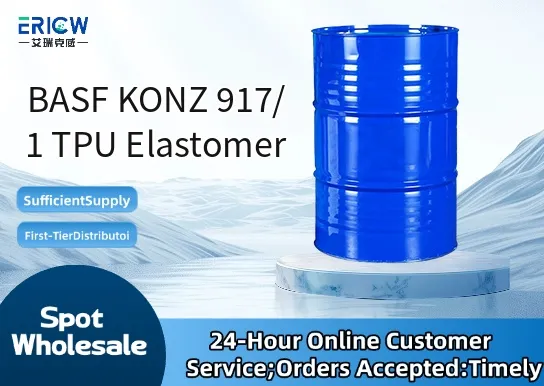
| Chemical Type | Thermoplastic Polyurethane (TPU), polyester-based |
| Product Form | Pellets |
| Appearance | Transparent, translucent granules |
| Primary Applications | Transparent elastomeric components, soft-touch overmolding, flexible tubing |
| Key Features | High clarity, excellent elasticity, good oil resistance, thermal processability |
| Benefits | Reduced part weight vs. rubber, recyclable processing, no vulcanization required |
| Density (g/cm³) | 1.18–1.22 |
| Melt Flow Index (230 °C / 2.16 kg, g/10 min) | 10–15 |
Q1: What is the primary function of BASF KONZ 917/1 in thermoplastic polyurethane (TPU) formulations?
A: KONZ 917/1 is a specialized processing aid designed to improve melt flow and reduce extrusion pressure during TPU compounding and profile extrusion. It enhances surface finish, reduces die build-up, and supports consistent throughput without compromising mechanical performance.
Q2: Is KONZ 917/1 compatible with aromatic and aliphatic TPU grades?
A: Yes — KONZ 917/1 has been formulated for broad compatibility across both aromatic and aliphatic TPU systems, including polyester- and polyether-based matrices. Compatibility should be confirmed via small-scale trials under intended processing conditions.
Q3: How is KONZ 917/1 typically incorporated into TPU production?
A: It is commonly added as a masterbatch or dry-blended directly with TPU pellets prior to extrusion. Dosage depends on formulation requirements and equipment configuration, but it is generally used at low concentrations to achieve optimal processing benefits.
Q4: Does KONZ 917/1 affect the final TPU’s thermal stability or long-term aging behavior?
A: When used within recommended dosage ranges, KONZ 917/1 does not negatively impact thermal stability or accelerate aging. However, prolonged exposure to elevated temperatures during extended residence times may influence performance—process optimization is advised.
Contact With Us:
E-mail: wangxingqiang@ericwchem.com
Have a Questions? Call Us:
Add:
Building A1, Jiete Industrial Park, Huangpu District, Guangzhou City, Guangdong Province, China