English
 Español
 tiếng việt
 русский
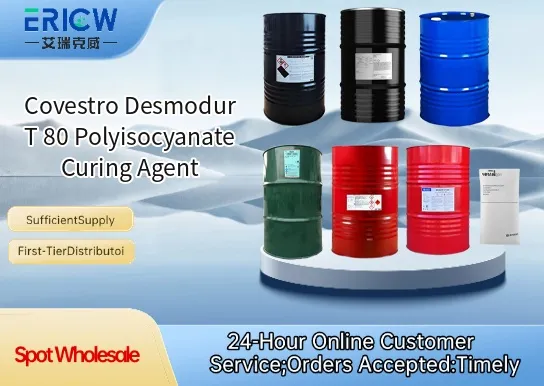
Highly reactive aromatic polyisocyanate based on toluene diisocyanate (TDI) prepolymers.
Optimized viscosity for excellent processability in spray, roller, and brush application systems.
Delivers superior hardness, chemical resistance, and gloss retention in cured polyurethane coatings.
Compatible with a wide range of hydroxyl-functional resins including acrylics, polyesters, and alkyds.
Enables formulation of high-performance two-component (2K) polyurethane systems with balanced pot life and cure speed.
Automotive OEM and refinish clearcoats and basecoats.
Industrial maintenance coatings for machinery, rail, and agricultural equipment.
Wood finishing systems including furniture, flooring, and cabinetry coatings.
Plastic coatings requiring flexibility and adhesion on ABS, PC, and PVC substrates.
General-purpose protective coatings for metal and concrete surfaces.
| Chemical Type | Aromatic polyisocyanate (TDI-based prepolymer) |
| Product Form | Liquid |
| Appearance | Clear, pale yellow to amber liquid |
| NCO Content (wt %) | 13.5 – 14.5 |
| Viscosity at 25 °C (mPa·s) | 800 – 1,200 |
| Density at 20 °C (g/cm³) | 1.19 – 1.23 |
| Primary Applications | 2K polyurethane topcoats and clearcoats |
| Key Features | Reactivity balance, low VOC potential, good film formation |
Q1: What is the primary chemical composition of Desmodur T 80?
A: Desmodur T 80 is a liquid aromatic polyisocyanate based predominantly on toluene diisocyanate (TDI) adducts, containing a mixture of biuret and uretdione structures. It is not a pure monomer but a low-viscosity, trifunctional crosslinker designed for ambient- or heat-cured polyurethane systems.
Q2: How does Desmodur T 80 differ from aliphatic polyisocyanates in coating applications?
A: Unlike aliphatic isocyanates (e.g., HDI or IPDI derivatives), Desmodur T 80 offers higher reactivity and improved hardness development at room temperature due to its aromatic backbone. However, it is not recommended for exterior topcoats requiring long-term UV stability, as aromatic systems are prone to yellowing and chalking upon prolonged UV exposure.
Q3: What solvents are commonly compatible with Desmodur T 80 in two-component polyurethane formulations?
A: Desmodur T 80 exhibits good miscibility with standard organic solvents used in industrial coatings, including acetates (e.g., ethyl acetate, butyl acetate), ketones (e.g., methyl isobutyl ketone), and aromatic hydrocarbons (e.g., xylene). It is generally incompatible with water, alcohols, and strong protic solvents, which can cause premature gelation.
Q4: Can Desmodur T 80 be used in moisture-cured or one-component systems?
A: No — Desmodur T 80 is specifically formulated as a two-component (2K) curing agent and requires intentional mixing with polyol resins. It is not suitable for moisture-cured or blocked one-component systems, as it lacks thermal blocking agents and reacts readily with ambient moisture, leading to viscosity increase and pot life reduction.
Contact With Us:
E-mail: wangxingqiang@ericwchem.com
Have a Questions? Call Us:
Add:
Building A1, Jiete Industrial Park, Huangpu District, Guangzhou City, Guangdong Province, China