English
 Español
 tiếng việt
 русский
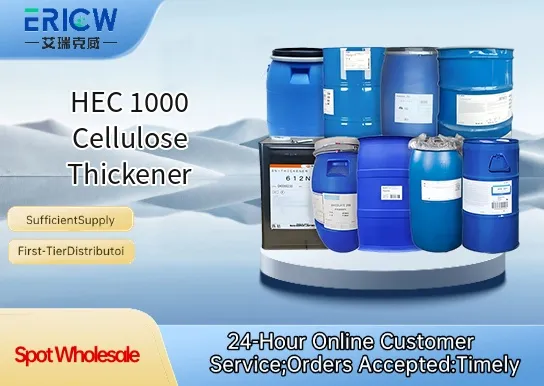
Highly efficient water-soluble thickener with excellent rheology control in aqueous systems.
Provides outstanding suspension stability for insoluble particles and pigments.
Delivers consistent viscosity performance across a broad pH range (3–11).
Non-ionic nature ensures compatibility with anionic, cationic, and non-ionic surfactants.
Low foam generation and excellent shear-thinning behavior for easy application and processing.
Architectural coatings and interior/exterior wall paints.
Tile adhesives and cement-based mortars.
Oilfield fracturing fluids and drilling mud additives.
Personal care formulations including shampoos and liquid soaps.
Agrochemical suspensions and herbicide concentrates.
| Chemical Type | Hydroxyethyl cellulose (HEC) |
| Product Form | White to off-white free-flowing powder |
| Appearance | Odorless, fine granular powder |
| Viscosity (1% aqueous solution, 25°C) | 900–1100 mPa·s |
| pH (1% aqueous solution) | 6.0–8.5 |
| Solubility | Readily soluble in cold water; forms clear, viscous solutions |
| Moisture Content | ≤5.0% (w/w) |
| Heavy Metals (as Pb) | ≤20 ppm |
Q1: What is the primary function of HEC 1000 in aqueous formulations?
A: HEC 1000 functions primarily as a non-ionic, water-soluble rheology modifier that imparts viscosity, improves suspension stability, and enhances film-forming properties in water-based systems.
Q2: How does HEC 1000 differ from other hydroxyethyl cellulose grades?
A: HEC 1000 is specifically engineered for balanced thickening efficiency and shear-thinning behavior, offering improved clarity and reduced sensitivity to electrolytes compared to lower-molecular-weight HEC variants — making it well-suited for demanding applications like architectural coatings and personal care gels.
Q3: Is HEC 1000 compatible with common preservatives and surfactants?
A: Yes, HEC 1000 demonstrates broad compatibility with typical non-ionic and anionic surfactants, as well as widely used cosmetic and industrial preservatives; however, compatibility testing under final formulation conditions is recommended due to potential interactions with cationic agents or high levels of multivalent ions.
Q4: What is the typical dosage range for effective viscosity development?
A: Effective thickening is typically achieved at low concentrations, generally ranging from 0.1% to 2% by weight, depending on the desired viscosity profile, formulation pH, ionic strength, and presence of co-thickeners or solvents.
Q5: Does HEC 1000 require special dispersion or activation procedures?
A: For optimal performance, HEC 1000 should be dispersed gradually under high shear to avoid agglomeration, followed by adequate hydration time; pre-dispersion in a water-miscible liquid (e.g., glycerin or propylene glycol) can further aid uniform wetting and reduce lump formation.
Contact With Us:
E-mail: wangxingqiang@ericwchem.com
Have a Questions? Call Us:
Add:
Building A1, Jiete Industrial Park, Huangpu District, Guangzhou City, Guangdong Province, China