English
 Español
 tiếng việt
 русский
High chroma and excellent brightness for vibrant yellow coloration.
Outstanding thermal stability up to 240 °C, suitable for high-temperature processing.
Good lightfastness (ISO 105-B02: Grade 7–8) and weather resistance in demanding applications.
Excellent dispersibility in organic media including PVC, polyolefins, and engineering thermoplastics.
Low volatile organic content (VOC) and compliant with major global regulatory frameworks (e.g., REACH, RoHS).
Coloration of rigid and flexible PVC profiles, films, and cables.
Pigmentation of polypropylene (PP) and polyethylene (PE) injection-molded parts.
Use in automotive interior plastics requiring long-term color stability.
Functional coloring of engineering plastics such as ABS and polycarbonate blends.
Masterbatch formulation for general-purpose industrial and consumer goods.
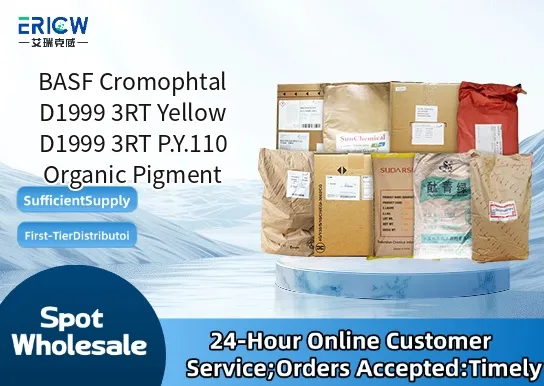
| Chemical Type | Azo pigment (Pigment Yellow 110) |
| Product Form | Dry powder, free-flowing granules |
| Appearance | Yellow to orange-yellow powder |
| Primary Applications | PVC, polyolefins, engineering plastics, masterbatches |
| Key Features | High heat stability, good dispersibility, low migration |
| Benefits | Bright hue, consistent batch-to-batch performance, low dust generation |
| Regulatory Compliance | REACH registered, RoHS compliant, non-hazardous per GHS |
| Storage Conditions | Store in cool, dry place; protect from moisture and direct sunlight |
Q1: What is the primary application field for Cromophtal D1999 3RT?
A: Cromophtal D1999 3RT is specifically engineered for high-performance industrial coatings, including automotive OEM and refinish systems, where excellent lightfastness, thermal stability, and dispersibility in solvent-borne and high-solids resin systems are required.
Q2: Is this pigment suitable for waterborne coating formulations?
A: While Cromophtal D1999 3RT is optimized for solvent-based and high-solids systems, it can be incorporated into waterborne coatings with appropriate surfactant-assisted dispersion or pre-treatment—however, performance consistency may vary depending on formulation pH, ionic strength, and binder compatibility.
Q3: How does D1999 3RT compare to standard P.Y.110 pigments in terms of processing behavior?
A: The 3RT grade features a tailored particle size distribution and surface treatment that enhances wetting, reduces viscosity buildup during grinding, and improves mill base stability—leading to more efficient dispersion and better batch-to-batch reproducibility in production-scale operations.
Q4: What are the key handling and storage recommendations?
A: Store in original sealed containers in a cool, dry place away from direct sunlight and sources of heat or ignition. Avoid prolonged exposure to moisture or high humidity, as this may affect dispersibility. Always follow BASF’s Safety Data Sheet (SDS) for safe handling, personal protective equipment, and disposal guidance.
Contact With Us:
E-mail: wangxingqiang@ericwchem.com
Have a Questions? Call Us:
Add:
Building A1, Jiete Industrial Park, Huangpu District, Guangzhou City, Guangdong Province, China