English
 Español
 tiếng việt
 русский
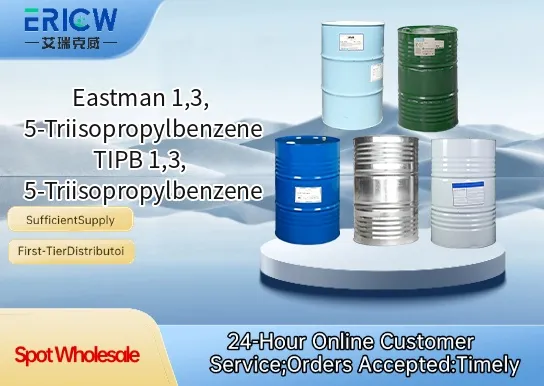
High steric hindrance due to three symmetrically positioned isopropyl groups, enabling selective reactivity in catalytic and synthetic applications.
Exceptional thermal and oxidative stability, supporting use in high-temperature process environments.
Low volatility and high boiling point, contributing to improved handling safety and reduced evaporative loss during storage and processing.
High chemical purity (>99.0% GC) with minimal ortho/meta isomer impurities, ensuring reproducible performance in precision chemistry.
Non-corrosive and compatible with common stainless steel and glass-lined process equipment.
Chemical intermediate in the synthesis of advanced ligands for transition-metal catalysts.
Stabilizing solvent or diluent in high-performance polymerization reactions, especially for metallocene and constrained geometry catalysts (CGCs).
Reference compound in nuclear magnetic resonance (NMR) spectroscopy for chemical shift calibration and relaxation studies.
Model substrate in mechanistic organic chemistry research to probe steric effects on electrophilic aromatic substitution kinetics.
Component in specialty electronic-grade cleaning formulations requiring inert, non-residual hydrocarbon solvents.
| Chemical Type | Aromatic hydrocarbon — sterically hindered trialkylbenzene |
| Product Form | Liquid at room temperature |
| Appearance | Clear, colorless to pale yellow liquid |
| Primary Applications | Catalyst synthesis, NMR reference, specialty solvent, research intermediate |
| Key Features | Symmetric 1,3,5-substitution, high steric bulk, thermal stability |
| Benefits | Enhanced selectivity, low volatility, compatibility with sensitive organometallic systems |
| Typical Purity (GC) | ≥ 99.0% |
| Boiling Point (760 mmHg) | Approx. 265–270 °C |
Contact With Us:
E-mail: wangxingqiang@ericwchem.com
Have a Questions? Call Us:
Add:
Building A1, Jiete Industrial Park, Huangpu District, Guangzhou City, Guangdong Province, China