English
 Español
 tiếng việt
 русский
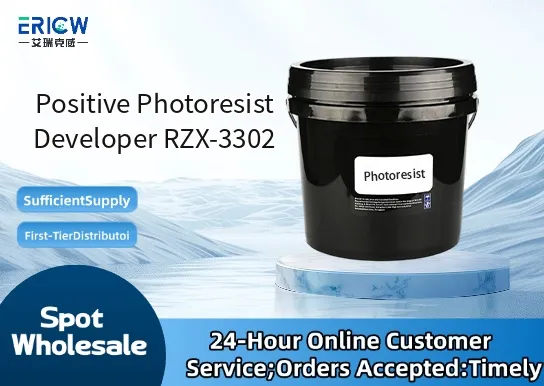
Optimized alkaline formulation for high-resolution development of g-line, i-line, and deep UV positive photoresists.
Consistent performance across wide temperature and concentration ranges—minimizes process drift in high-volume manufacturing.
Low metal ion content (<10 ppb Na, K, Fe) to prevent contamination in semiconductor and MEMS fabrication environments.
Controlled dissolution rate ensures sharp sidewall profiles and excellent CD (critical dimension) uniformity.
Stable shelf life (>12 months unopened at 25 °C) with no phase separation or precipitation under standard storage conditions.
Semiconductor front-end-of-line (FEOL) photolithography for 0.35–0.13 µm node processes.
Advanced packaging applications including fan-out wafer-level packaging (FOWLP) and redistribution layer (RDL) patterning.
MEMS and microfluidic device fabrication requiring high-fidelity resist profile control.
Flat panel display (FPD) array substrate patterning using i-line steppers and scanners.
LED and power device manufacturing where low defect density and residue-free development are critical.
| Chemical Type | Aqueous tetramethylammonium hydroxide (TMAH) solution |
| Product Form | Liquid concentrate (2.38 wt% TMAH in deionized water) |
| Appearance | Clear, colorless, odorless liquid |
| pH (1× diluted, 25 °C) | 13.4 ± 0.2 |
| Primary Applications | Positive-tone photoresist development for semiconductor, MEMS, FPD, and advanced packaging |
| Key Features | Low particle count (<5 particles/mL @ ≥0.2 µm), ultra-low metallic impurities, ISO Class 5 cleanroom compatible |
| Benefits | Improved yield via reduced scumming, enhanced process window, and compatibility with automated track systems |
| Regulatory Compliance | REACH compliant; RoHS 2015/863 Annex II compliant; SDS available per GHS Rev. 8 |
| Common Compatible Systems | Suitability |
| TOK PAK series (e.g., PAK-3000, PAK-5000) | Highly Recommended – Validated for full process integration with minimal optimization |
| Dow Electronic Materials (formerly Rohm and Haas) SPR series (e.g., SPR220, SPR955) | Highly Recommended – Consistent CD control and develop rate matching per datasheet guidelines |
| Fujifilm Fujitrack™ and JSR NLD series resists | Recommended – Requires minor concentration adjustment (±0.1 wt%) for optimal throughput |
| ASML & Nikon lithography tracks (e.g., ASML XT:1950i, Nikon NSR-S630D) | Suitable – Fully qualified for inline use with standard developer dispense modules |
Q1: What is the CAS Registry Number for RZX-3302?
A: RZX-3302 is a proprietary aqueous formulation; its base active ingredient, tetramethylammonium hydroxide monohydrate, has CAS No. 75-59-2. Full product CAS is not assigned as it is a multi-component commercial mixture under REACH Article 3(2).
Q2: What is the recommended working concentration and temperature range?
A: Standard operating concentration is 2.38 wt% TMAH at 23 ± 1 °C. Temperature may be adjusted between 20–25 °C to fine-tune develop rate; deviations beyond this range require requalification per IPC-4552B.
Q3: How does RZX-3302 compare to generic TMAH developers in terms of residue and microbridging?
A: RZX-3302 contains proprietary surfactant and chelating additives that reduce surface tension by ~22% and suppress metal-induced microbridging—demonstrated via SEM cross-section analysis showing >99.98% bridge-free features at 0.18 µm line/space.
Q4: Is RZX-3302 certified for use in automotive-grade (AEC-Q200) or medical device (ISO 13485) production lines?
A: Yes—RZX-3302 is manufactured in an ISO 9001:2015 and ISO 14001:2015 certified facility. Lot-specific CoA and traceability documentation support AEC-Q200 qualification; ISO 13485 compliance applies to the manufacturing system (not final product classification, which is determined by end-device validation).
Q5: Has migration or extractables testing been performed per USP <87> / <88> or ICH Q5C guidelines?
A: Extractables profiling per USP <87> (in vitro cytotoxicity) and <88> (implantation testing) confirms non-cytotoxic behavior at relevant process dilutions. No leachables detected above ICH Q5C identification thresholds (10 ppm) in silicon wafers post-development and rinse cycles.
Contact With Us:
E-mail: wangxingqiang@ericwchem.com
Have a Questions? Call Us:
Add:
Building A1, Jiete Industrial Park, Huangpu District, Guangzhou City, Guangdong Province, China