English
 Español
 tiếng việt
 русский
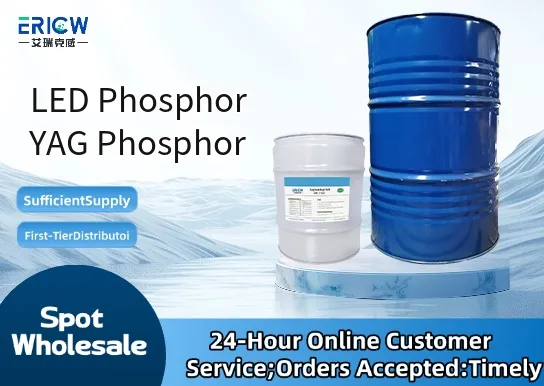
High quantum efficiency (>90%) under 450–470 nm blue LED excitation.
Excellent thermal and photochemical stability for long-lifetime solid-state lighting.
Narrow particle size distribution (D50 ≈ 8–12 μm) enabling uniform dispersion in silicone matrices.
Controlled crystallinity and phase purity (Y₃Al₅O₁₂:Ce³⁺) ensuring consistent color rendering (CRI > 75).
Low halide residue and minimal heavy metal impurities, compliant with RoHS and REACH pre-registration requirements.
White LED packages for general illumination (A19, PAR30, T8 tubes).
Backlight units (BLUs) in LCD displays, including monitors and large-format TVs.
Automotive headlamp and daytime running light (DRL) modules.
UV-curable phosphor-in-silicone (PiS) dispensing systems for high-power COB LEDs.
Specialty lighting solutions requiring high lumen density and stable CCT (e.g., horticultural supplemental lighting).
| Chemical Type | Yttrium Aluminum Garnet doped with Cerium (Y₃Al₅O₁₂:Ce³⁺) |
| Product Form | Free-flowing micronized powder |
| Appearance | Yellow-green to pale yellow crystalline powder |
| Melting Point | Decomposes above 1900 °C (no true melting; garnet structure remains stable) |
| Primary Applications | Blue-pump white LED conversion phosphor |
| Key Features | High photoluminescence quantum yield, low thermal quenching (<15% at 150 °C) |
| Benefits | Enables high-efficiency, high-CCT consistency, and extended LED package lifetime |
| Regulatory Compliance | RoHS 2015/863 compliant; REACH SVHC-free; no intentional addition of lead, cadmium, or mercury |
| Common Compatible Systems | Suitability |
| High-viscosity addition-cure silicone (e.g., Dow SYLGARD™ 184 + catalyst) | Highly Recommended – Excellent dispersion stability and optical clarity post-cure |
| Platinum-catalyzed liquid silicone rubber (LSR) formulations | Highly Recommended – Minimal catalyst poisoning and consistent viscosity retention |
| Epoxy-based encapsulants (e.g., Sumitomo EPX-200 series) | Recommended – Requires surface treatment for optimal adhesion; moderate thermal cycling performance |
| UV-curable acrylate resins | Suitable – Acceptable for low-heat applications; limited long-term UV stability without stabilizers |
Q1: What is the CAS Registry Number for YAG:Ce phosphor?
A: The CAS number for cerium-doped yttrium aluminum garnet (Y₃Al₅O₁₂:Ce) is 12004-04-1. Note that this identifier applies to the stoichiometric, crystalline compound as synthesized.
Q2: What is the typical loading concentration in silicone encapsulants?
A: Standard loading ranges from 12–22 wt% depending on target CCT (e.g., 18–22% for 4000–5000 K; 12–16% for 6500 K), optimized via spectral simulation and empirical validation.
Q3: How does YAG:Ce compare to nitride-based red phosphors (e.g., CaAlSiN₃:Eu²⁺) in terms of compatibility and stability?
A: YAG:Ce exhibits superior resistance to moisture and oxidation versus nitride phosphors, requires no hermetic packaging, and shows negligible degradation in standard silicone matrices—unlike nitrides, which often demand rigorous moisture control and barrier coatings.
Q4: Is migration or leaching of Ce³⁺ ions observed under LED operating conditions?
A: No measurable Ce³⁺ ion migration occurs under normal LED operation (≤150 °C junction temperature, dry silicone environment); the Ce³⁺ is substitutionally locked in the YAG lattice and not bioavailable or extractable by common solvents per IEC 62321-7-2 testing.
Contact With Us:
E-mail: wangxingqiang@ericwchem.com
Have a Questions? Call Us:
Add:
Building A1, Jiete Industrial Park, Huangpu District, Guangzhou City, Guangdong Province, China