English
 Español
 tiếng việt
 русский
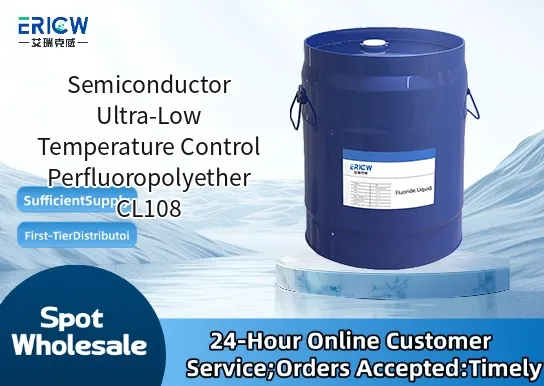
Exceptionally low volatility and negligible vapor pressure at operating temperatures (−60 °C to +200 °C), ensuring stable thermal management without evaporative loss.
Chemically inert toward silicon, quartz, aluminum, stainless steel, and common elastomers—minimizing contamination risk in ultra-clean semiconductor processing environments.
Non-flammable, non-toxic, and ozone-safe with zero halogen content—fully compliant with industrial safety and environmental stewardship requirements.
Outstanding thermal stability with no measurable decomposition below 300 °C, enabling long service life in recirculating chiller systems.
Ultra-low particulate generation and non-volatile residue (<0.001% volatiles at 150 °C), meeting SEMI F57 purity standards for critical thermal control applications.
Temperature stabilization of photolithography steppers and scanners during high-precision exposure cycles.
Cooling fluid for plasma etch and CVD chamber temperature control units requiring chemical compatibility and particle-free operation.
Thermal interface medium in advanced packaging test handlers and wafer-level burn-in systems.
Heat transfer fluid in high-reliability immersion cooling loops for semiconductor metrology equipment (e.g., OCD, CD-SEM).
Dielectric coolant for high-power RF test fixtures and probe station thermal plates where electrical isolation is essential.
| Chemical Type | Perfluoropolyether (PFPE), linear dimethyl ether structure |
| Product Form | Ambient-stable, colorless liquid |
| Appearance | Clear, water-white, odorless |
| Melting Point | −65 °C (typical) |
| Boiling Point (at 760 torr) | Decomposes >300 °C; no true boiling point |
| Density (25 °C) | 1.82–1.85 g/cm³ |
| Viscosity (40 °C) | 175–185 cSt |
| Regulatory Compliance | REACH SVHC-free; RoHS 2-compliant; FDA 21 CFR 178.3570 (indirect food contact); ISO 14001 & OHSAS 18001 compatible |
| Common Compatible Systems | Suitability |
| Julabo FP Series Ultra-Low-Temp Chillers | Highly Recommended – Verified compatibility with pump seals, sensors, and heat exchangers; no system modification required |
| Lauda Proline RP Series Precision Circulators | Highly Recommended – Stable performance across full temperature range (−60 °C to +200 °C); validated for extended duty cycles |
| Thermo Fisher Polyscience 7000 Series Recirculating Baths | Recommended – Requires fluorocarbon-compatible tubing and Viton®/Kalrez® seals; consult OEM for firmware updates |
| Custom-built semiconductor process chillers (e.g., ATS, Lytron) | Suitable – Compatible with stainless steel, Hastelloy®, and PFA-wetted components; verify elastomer selection per OEM spec sheet |
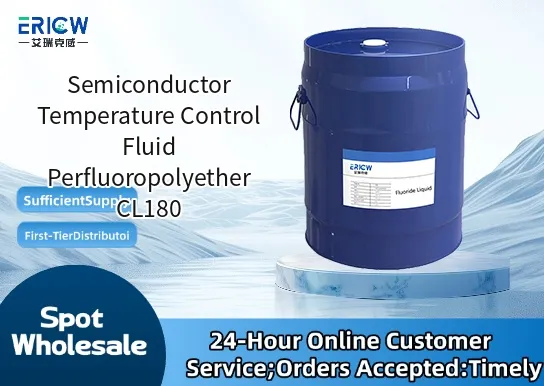
Q1: What is the CAS Registry Number for CL180?
A: The CAS Registry Number for Semiconductor Temperature Control Fluid Perfluoropolyether CL180 is 60168-88-9 (generic PFPE K-type structure; exact molecular weight distribution is proprietary).
Q2: How much CL180 is typically required to fill a standard 5 kW semiconductor process chiller?
A: Typical fill volume ranges from 8 to 14 liters depending on loop length, reservoir size, and heat exchanger geometry; always perform a system flush with isopropyl alcohol prior to initial fill to remove hydrocarbon residues.
Q3: How does CL180 compare to Galden® HT 170 or Fomblin® Y LVAC 18/6 in terms of thermal stability and metal compatibility?
A: CL180 exhibits comparable thermal stability (>300 °C) but superior resistance to aluminum corrosion under humidified conditions and lower extractables vs. Galden® HT 170; unlike Fomblin® Y LVAC 18/6, CL180 contains no end-group instability risks (no –COF termination), reducing potential fluoride ion migration.
Q4: Does CL180 meet EU SCIP database reporting requirements under the Waste Framework Directive?
A: Yes—CL180 contains no substances listed on the EU Candidate List of SVHCs; full SCIP-ready dossier (including UFI code and composition details) is available upon request via certified supplier portal.
Q5: Has CL180 been evaluated for extractables/migration into photoresist layers during thermal plate contact?
A: Yes—per SEMI F21-0312 testing, CL180 demonstrates <0.1 ppb total organic extractables (TOE) after 72 h at 120 °C on chrome-coated silicon wafers; no detectable impact on resist adhesion or post-exposure bake profiles.
Contact With Us:
E-mail: wangxingqiang@ericwchem.com
Have a Questions? Call Us:
Add:
Building A1, Jiete Industrial Park, Huangpu District, Guangzhou City, Guangdong Province, China