English
 Español
 tiếng việt
 русский
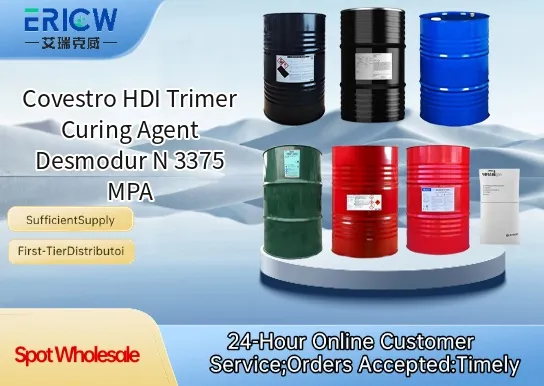
Low-viscosity aliphatic isocyanate trimer offering excellent flow and leveling in coating formulations.
Excellent UV stability and color retention, ideal for high-performance exterior coatings.
Good compatibility with a wide range of hydroxyl-functional resins including acrylics, polyesters, and polycarbonates.
Reactive NCO content optimized for balanced pot life and rapid ambient or forced-dry cure performance.
Free from solvents and aromatic isocyanates — supports low-VOC and safer handling profiles.
Automotive OEM and refinish clearcoats requiring exceptional gloss and durability.
Industrial maintenance coatings for metal substrates exposed to harsh outdoor environments.
High-end plastic coatings for automotive interior trim and consumer electronics housings.
Architectural pre-finished metal (PPM) coatings demanding long-term weather resistance.
| Chemical Type | Aliphatic HDI-based isocyanurate trimer |
| Product Form | Liquid |
| Appearance | Clear, pale yellow liquid |
| NCO Content (wt %) | 15.8 – 16.4 |
| Viscosity at 25 °C (mPa·s) | 1,800 – 2,400 |
| Density at 20 °C (g/cm³) | 1.18 – 1.20 |
| Flash Point (PMCC, °C) | 145 – 155 |
| Storage Stability | ≥12 months in sealed original container at ≤25 °C |
Q1: What is the primary function of Desmodur N 3375 MPA in coating formulations?
A: Desmodur N 3375 MPA is an aliphatic HDI-based trimer polyisocyanate curing agent designed to react with hydroxyl-functional resins—such as acrylics, polyesters, or polyethers—to form durable, high-performance thermoset coatings. It delivers excellent gloss retention, weather resistance, and mechanical properties in demanding industrial and automotive topcoat applications.
Q2: How does Desmodur N 3375 MPA differ from standard HDI trimers?
A: Desmodur N 3375 MPA is a monomeric polyisocyanate (MPA) variant, meaning it contains a higher proportion of low-viscosity, non-uretdione monomeric species compared to conventional uretdione-stabilized HDI trimers. This results in lower viscosity, improved compatibility with diverse resin systems, and enhanced reactivity without requiring elevated cure temperatures.
Q3: Is Desmodur N 3375 MPA suitable for low-VOC or high-solids coating systems?
A: Yes—its inherently low viscosity and high NCO content allow formulators to reduce solvent demand while maintaining workable rheology and pot life. It is widely used in high-solids, solventborne industrial coatings where VOC compliance and film performance are both critical.
Q4: What are typical handling and storage recommendations?
A: Store in tightly sealed containers under dry, cool conditions (preferably below 30 °C) and protect from moisture, heat, and direct sunlight. Due to its isocyanate functionality, it must be handled using appropriate personal protective equipment (PPE), including chemical-resistant gloves and respiratory protection when aerosols or vapors may be present.
Q5: Can Desmodur N 3375 MPA be used in ambient-cure systems?
A: While it exhibits higher reactivity than many conventional HDI trimers, full ambient cure typically requires catalysis (e.g., with dibutyltin dilaurate or other tertiary amine catalysts) and careful formulation balancing. It is most commonly applied in forced-dry or moderate-bake systems (e.g., 60–100 °C), where optimal crosslink density and durability are achieved.
Contact With Us:
E-mail: wangxingqiang@ericwchem.com
Have a Questions? Call Us:
Add:
Building A1, Jiete Industrial Park, Huangpu District, Guangzhou City, Guangdong Province, China