English
 Español
 tiếng việt
 русский
Excellent clarity and gloss for high-end aesthetic applications.
Good impact resistance and toughness at room temperature.
Low moisture absorption compared to standard polyesters.
Excellent processability in injection molding and extrusion.
Compliant with FDA 21 CFR §177.1810 for food-contact applications.
Reusable food and beverage containers.
Medical device housings requiring transparency and sterilizability.
Consumer electronics enclosures and transparent components.
Point-of-purchase displays and retail packaging.
Personal care product bottles and caps.
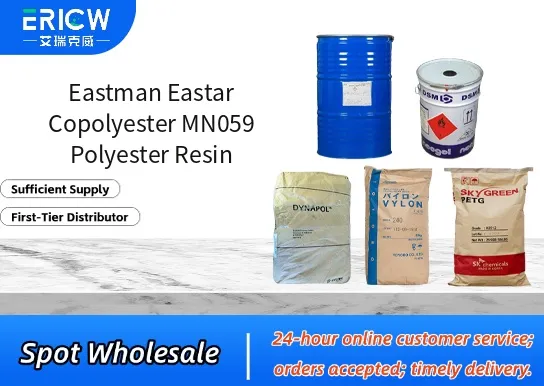
| Chemical Type | Copolyester (PET-based, cyclohexanedimethanol-modified) |
| Product Form | Pellets |
| Appearance | Translucent, off-white to pale yellow pellets |
| Primary Applications | Injection-molded rigid packaging and durable consumer goods |
| Key Features | Clarity, toughness, low moisture sensitivity, thermal stability |
| Benefits | Replacement for polycarbonate in non-load-bearing transparent parts; no BPA |
| Processing Method | Injection molding, extrusion |
| Regulatory Compliance | FDA 21 CFR §177.1810, EU Regulation (EC) No. 10/2011 |
Q1: What is the primary functional role of Eastman Eastar Copolyester MN059 in polymer formulations?
A: Eastar MN059 functions primarily as a non-migrating, low-volatility processing aid and compatibilizer—enhancing melt flow, reducing viscosity during extrusion or injection molding, and improving interfacial adhesion between dissimilar polymers or fillers.
Q2: Is Eastar MN059 suitable for food-contact applications?
A: Yes, Eastar MN059 is designed for use in food-contact plastics compliant with FDA 21 CFR §177.1810 for polyester resins, and it meets applicable requirements for indirect food contact when used within recommended formulation limits and processing conditions.
Q3: How does Eastar MN059 differ from conventional plasticizers like phthalates or adipates?
A: Unlike small-molecule plasticizers, Eastar MN059 is a high-molecular-weight copolyester resin that remains permanently bound within the polymer matrix—eliminating volatility, migration, and leaching concerns commonly associated with traditional plasticizers.
Q4: What types of polymers is Eastar MN059 typically blended with?
A: It is widely compatible with polyesters (including PET and PBT), polycarbonate, thermoplastic polyurethanes, and certain bio-based polymers—often used to improve toughness, processability, or clarity without sacrificing thermal stability.
Contact With Us:
E-mail: wangxingqiang@ericwchem.com
Have a Questions? Call Us:
Add:
Building A1, Jiete Industrial Park, Huangpu District, Guangzhou City, Guangdong Province, China