English
 Español
 tiếng việt
 русский
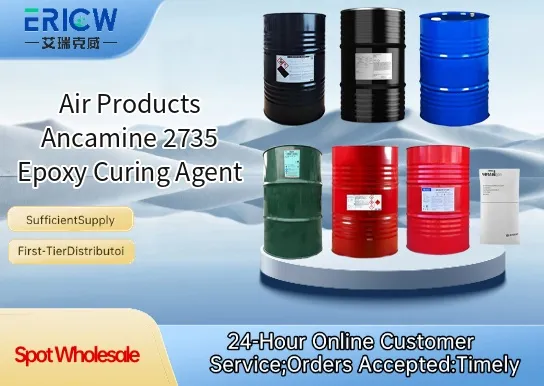
Low-viscosity, solvent-free polyamine-based curing agent for improved handling and mixing efficiency.
Enables rapid room-temperature cure with excellent mechanical properties and chemical resistance.
Offers superior adhesion to metals, composites, and concrete substrates.
Low exotherm profile supports thick-section casting and minimizes thermal stress.
Meets UL 94 V-0 flammability requirements when formulated in appropriate epoxy systems.
Structural adhesives for aerospace and transportation bonding.
Electrical encapsulants and potting compounds for power electronics.
High-performance coatings for industrial flooring and protective linings.
Composite matrix resins in wind blade and marine applications.
Tooling and mold-making compounds requiring dimensional stability and low shrinkage.
| Chemical Type | Polyamine adduct |
| Product Form | Liquid |
| Appearance | Clear to pale yellow, homogeneous liquid |
| Primary Applications | Structural adhesives, encapsulants, coatings, composites |
| Key Features | Room-temperature cure, low viscosity, low exotherm, UL 94 V-0 capable |
| Benefits | Improved processability, enhanced interfacial adhesion, reduced post-cure requirements |
| Storage Stability | 12 months at 25°C in original unopened container |
Q1: What is the primary chemical class of Ancamine 2735?
A: Ancamine 2735 is a modified aliphatic amine curing agent, designed to offer balanced reactivity, low volatility, and improved handling characteristics compared to conventional aliphatic amines.
Q2: Is Ancamine 2735 suitable for ambient-cure epoxy systems?
A: Yes — it is specifically formulated for ambient-temperature cure applications, delivering reliable crosslinking without forced heat, while maintaining acceptable pot life and film formation properties in coatings and adhesives.
Q3: How does Ancamine 2735 compare to standard DETA or TETA in terms of odor and skin sensitization risk?
A: It exhibits significantly reduced volatility and amine odor versus traditional low-molecular-weight amines like DETA or TETA, and its modified structure contributes to lower dermal sensitization potential — though appropriate industrial hygiene practices remain essential.
Q4: Can Ancamine 2735 be used in high-solids or solvent-free epoxy formulations?
A: Yes — its low viscosity and compatibility with common epoxy resins make it well-suited for high-solids, low-VOC, and 100%-solids epoxy systems, including flooring, grouts, and structural adhesives.
Q5: What guidance should formulators follow regarding stoichiometry and dosage?
A: Dosage depends on the epoxy resin’s equivalent weight and desired performance profile; it is typically used at low concentrations relative to resin weight, and optimal ratios should be determined empirically through small-scale cure and property testing.
Contact With Us:
E-mail: wangxingqiang@ericwchem.com
Have a Questions? Call Us:
Add:
Building A1, Jiete Industrial Park, Huangpu District, Guangzhou City, Guangdong Province, China