English
 Español
 tiếng việt
 русский
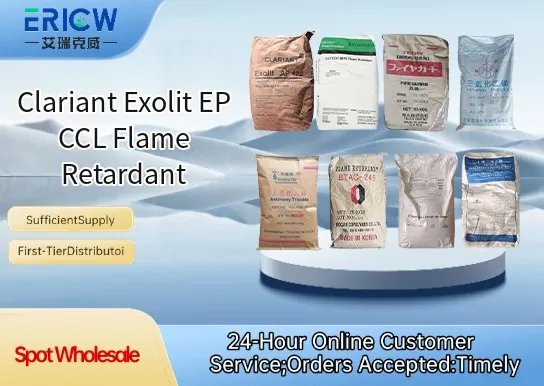
Halogen-free, phosphorus-based flame retardant offering excellent fire safety performance without generating corrosive or toxic fumes during combustion.
Designed for high thermal stability—maintains integrity and efficacy in engineering thermoplastics processed at elevated temperatures (e.g., up to 320 °C).
Provides outstanding electrical insulation properties, making it ideal for applications requiring UL 94 V-0 and CTI >600 V compliance.
Offers excellent polymer compatibility and dispersion in polyamide 6 and polyamide 66 matrices without significant impact on mechanical strength or surface appearance.
Supports sustainable manufacturing with low environmental persistence and no REACH SVHC listing under current regulations.
Electrical and electronic components—including connectors, circuit breakers, and housing parts for consumer and industrial equipment.
Automotive interior parts such as fuse boxes, sensor housings, and under-hood components requiring stringent flammability and tracking resistance.
Industrial automation housings and control units where long-term thermal reliability and arc resistance are critical.
Power tools and household appliance casings subject to IEC 60695-11-10 needle flame and glow-wire ignition test requirements.
3D-printed functional prototypes and end-use parts in flame-retardant PA6/PA66 filaments for certified applications.
| Chemical Type | Organophosphorus compound (phosphinate-based) |
| Product Form | Free-flowing white granules |
| Appearance | Off-white to pale yellow granules |
| Primary Applications | Polyamide 6 and polyamide 66 compounds |
| Key Features | Halogen-free, UL 94 V-0 rated (at ≥15 wt% loading in PA6), RoHS compliant |
| Benefits | Low smoke density, high comparative tracking index (CTI), minimal effect on tensile modulus |
| Density (g/cm³) | 1.5–1.6 |
| Recommended Loading Range | 12–20 wt% depending on polymer grade and flame rating target |
Q1: What is the primary application area for Exolit EP CCL?
A: Exolit EP CCL is specifically developed for flame retardancy in polyolefin-based cable compounds, particularly low-smoke zero-halogen (LSZH) insulation and jacketing materials used in building wiring, data cables, and rail transport applications.
Q2: How does Exolit EP CCL achieve flame retardancy without halogens?
A: It functions via an intumescent mechanism—releasing non-flammable gases and forming a thermally insulating char layer upon exposure to heat—thereby suppressing flame spread and reducing smoke generation in compliance with halogen-free requirements.
Q3: Is Exolit EP CCL compatible with common polyolefin processing methods?
A: Yes—it is designed for compatibility with standard compounding techniques including twin-screw extrusion and is stable under typical polyolefin processing temperatures, supporting good dispersion and minimal plate-out during high-speed cable extrusion.
Q4: What are the key handling and storage recommendations?
A: Store in a cool, dry place in original sealed packaging to prevent moisture uptake; avoid prolonged exposure to ambient humidity prior to use, as it may affect dispersion performance in hydrophobic polymer matrices.
Q5: How does dosage affect mechanical properties in the final compound?
A: Due to its optimized particle morphology and surface treatment, Exolit EP CCL typically enables effective flame retardancy at relatively low loadings, helping preserve tensile strength and elongation—though optimal dosage depends on formulation requirements and target fire performance class.
Contact With Us:
E-mail: wangxingqiang@ericwchem.com
Have a Questions? Call Us:
Add:
Building A1, Jiete Industrial Park, Huangpu District, Guangzhou City, Guangdong Province, China