English
 Español
 tiếng việt
 русский
Highly selective bismuth-based catalyst optimized for oxidative dehydrogenation reactions.
Thermally stable formulation enabling consistent performance under elevated process temperatures.
Low volatility and minimal leaching, ensuring long catalyst lifetime and reduced metal contamination in products.
Engineered for excellent dispersion on inert ceramic supports, maximizing active surface area.
Compatible with standard industrial fixed-bed reactor configurations and regeneration protocols.
Production of butadiene via oxidative dehydrogenation of butenes.
Selective oxidation of propylene to acrolein in acrylic acid precursor synthesis.
Dehydrogenation of isobutane to isobutylene for MTBE and butyl rubber manufacturing.
Conversion of ethanol to acetaldehyde in fine chemical intermediates production.
Catalytic upgrading of bio-derived oxygenates in sustainable chemical processes.
| Chemical Type | Bismuth oxide (Bi₂O₃) supported on high-surface-area α-alumina |
| Product Form | Extruded cylindrical pellets (3–4 mm diameter × 4–6 mm length) |
| Appearance | Grayish-white solid granules |
| Primary Applications | Oxidative dehydrogenation and selective oxidation of light alkenes/alkanes |
| Key Features | High selectivity, thermal stability up to 550 °C, low bismuth volatility |
| Benefits | Extended cycle life, reduced downstream purification burden, compatibility with existing ODH units |
| Storage Condition | Dry, ambient temperature, protected from moisture and strong oxidizers |
| Packaging | 25 kg sealed poly-lined steel drums or 500 kg IBCs |
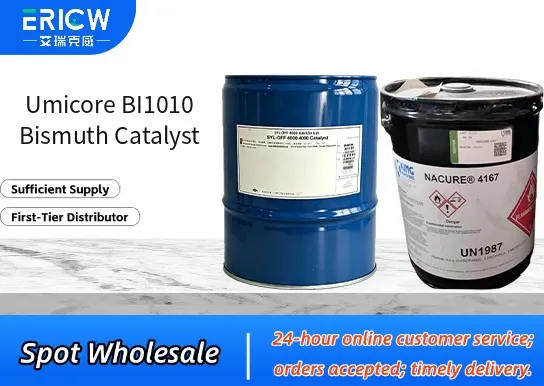
Q1: What is the primary function of Umicore BI1010 in polyurethane and silicone formulations?
A: Umicore BI1010 is a bismuth-based catalyst designed to promote urethane formation and crosslinking reactions, offering selective activity with reduced toxicity profile compared to traditional tin catalysts. It supports efficient gelation and cure development while maintaining good pot life control.
Q2: How does BI1010 compare to dibutyltin dilaurate (DBTDL) in terms of regulatory compliance and handling safety?
A: BI1010 is formulated as a non-tin, heavy-metal-reduced alternative to DBTDL. It avoids the regulatory restrictions and occupational exposure concerns associated with organotin compounds, making it suitable for applications where stricter environmental and health requirements apply—without compromising catalytic performance in many standard systems.
Q3: Is BI1010 compatible with common polyol types and isocyanates used in flexible and rigid foam production?
A: Yes, BI1010 demonstrates broad compatibility with conventional polyether and polyester polyols, as well as aromatic and aliphatic isocyanates. Its performance may vary depending on formulation pH, moisture content, and co-catalyst presence, so lab-scale evaluation is recommended for new system integration.
Q4: What are the recommended storage conditions to maintain BI1010 stability?
A: Store BI1010 in its original sealed container at temperatures between 5 °C and 30 °C, away from direct sunlight and strong oxidizing agents. Prolonged exposure to high humidity or elevated temperatures may affect viscosity and catalytic consistency over time.
Contact With Us:
E-mail: wangxingqiang@ericwchem.com
Have a Questions? Call Us:
Add:
Building A1, Jiete Industrial Park, Huangpu District, Guangzhou City, Guangdong Province, China