English
 Español
 tiếng việt
 русский
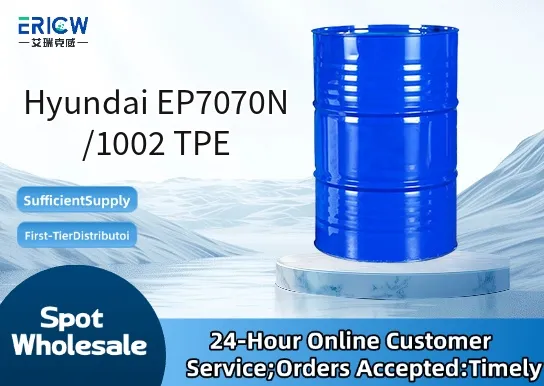
Excellent melt processability for high-speed extrusion and injection molding.
Superior soft-touch feel with balanced hardness (Shore A 70) and elasticity.
Good resistance to UV exposure and thermal aging under typical processing conditions.
Low extractables and compliant with FDA 21 CFR §177.2600 for food-contact applications.
Compatible with polypropylene (PP) and polyethylene (PE) substrates for co-extrusion and overmolding.
Soft-grip handles for power tools and hand-held appliances.
Sealing profiles and gaskets in automotive interior trim components.
Flexible tubing and connectors for medical device assemblies.
Overmolded consumer electronics casings requiring tactile feedback and impact absorption.
Food-grade squeeze bottles and dispensing caps requiring compliance and flexibility.
| Chemical Type | Thermoplastic Elastomer (TPE), Styrenic Block Copolymer (SBC)-based |
| Product Form | Pellets |
| Appearance | Off-white, translucent granules |
| Shore Hardness (A Scale) | 70 ± 3 |
| Melt Flow Rate (200°C/5 kg) | 18–22 g/10 min |
| Density | 0.91–0.93 g/cm³ |
| Key Features | Soft-touch, recyclable, halogen-free, low odor |
| Primary Applications | Overmolding, extrusion profiles, flexible packaging components |
Q1: What is the primary application domain for Hyundai EP7070N/1002 TPE?
A: Hyundai EP7070N/1002 TPE is a thermoplastic elastomer specifically engineered for soft-touch overmolding applications—particularly in automotive interior components such as control knobs, gear shift boots, and dashboard trim elements where tactile comfort, durability, and aesthetic consistency are critical.
Q2: Is this grade compatible with common thermoplastic substrates like PP, ABS, or PC?
A: Yes, EP7070N/1002 TPE exhibits strong adhesion to polypropylene (PP) and ABS substrates without requiring primers or surface treatment under standard injection overmolding conditions. Adhesion to polycarbonate (PC) may require process optimization or minor formulation adjustments depending on part geometry and thermal history.
Q3: What processing methods are recommended for this material?
A: Hyundai EP7070N/1002 TPE is optimized for conventional injection molding and two-shot (multi-component) molding processes. It demonstrates good melt stability, low compression set, and consistent flow behavior across typical processing temperatures—making it suitable for high-volume automotive production environments.
Q4: Does this TPE grade meet automotive industry requirements for low VOC and fogging performance?
A: Yes, EP7070N/1002 is formulated to support low-VOC and low-fogging performance when processed under controlled conditions—consistent with OEM expectations for interior trim materials. Final emissions profiles depend on drying, melt temperature, residence time, and mold ventilation during production.
Q5: How should this TPE be dried prior to processing?
A: To ensure optimal mechanical properties and surface quality, Hyundai EP7070N/1002 TPE should be dried at 70–80 °C for 2–4 hours using a desiccant dryer. Residual moisture content should be maintained below 0.05% to prevent splay, reduced tensile strength, or compromised adhesion in overmolded parts.
Contact With Us:
E-mail: wangxingqiang@ericwchem.com
Have a Questions? Call Us:
Add:
Building A1, Jiete Industrial Park, Huangpu District, Guangzhou City, Guangdong Province, China