English
 Español
 tiếng việt
 русский
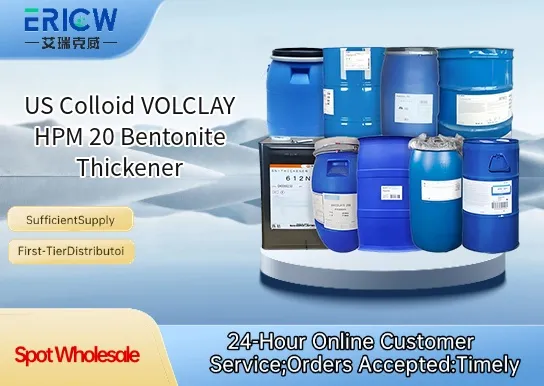
High-yield, sodium-activated bentonite offering exceptional thixotropic control in water-based systems.
Consistent rheology performance across varying pH and electrolyte concentrations.
Low-dosage efficiency—delivers optimal viscosity and suspension stability at minimal loading levels.
Free-flowing, dust-minimized powder formulation for safer handling and improved dispersion.
USP-grade compliant raw material sourcing with rigorous quality control per ASTM D5558 and ISO 9001 standards.
Water-based paints and architectural coatings requiring sag resistance and anti-settling properties.
Drilling fluids for geotechnical and environmental borehole stabilization.
Tile adhesives and cementitious grouts needing extended open time and vertical build.
Fireproofing and intumescent coatings where controlled rheology ensures uniform application.
Agrochemical suspensions and pesticide formulations requiring long-term particle suspension.
| Chemical Type | Sodium-activated montmorillonite clay |
| Product Form | Free-flowing fine powder |
| Appearance | Off-white to light tan, dry granular powder |
| Primary Applications | Rheology modifier in water-based industrial formulations |
| Key Features | Thixotropy, suspension aid, yield value enhancement |
| Benefits | Reduces settling, improves sag resistance, enables low-shear stability |
| pH Range (1% slurry) | 8.5 – 10.5 |
| Moisture Content (max) | 10.0 wt% |
Q1: What is the primary function of VOLCLAY HPM 20 in formulations?
A: VOLCLAY HPM 20 is a sodium-activated bentonite designed to provide efficient rheological control—primarily yield value development, suspension stabilization, and viscosity enhancement—in water-based systems such as coatings, adhesives, sealants, and construction mortars.
Q2: How does VOLCLAY HPM 20 differ from standard bentonite thickeners?
A: VOLCLAY HPM 20 is a high-purity, pre-hydrated, and surface-modified bentonite with optimized particle dispersion characteristics. It offers faster hydration kinetics, improved compatibility with common co-thickeners, and reduced sensitivity to electrolytes compared to conventional raw bentonites—enabling more consistent performance in complex formulations.
Q3: Is VOLCLAY HPM 20 suitable for use in low-VOC or zero-VOC systems?
A: Yes—VOLCLAY HPM 20 is inherently free of volatile organic compounds and requires no organic solvents for activation. It is widely used in environmentally compliant, waterborne systems where VOC reduction is a key formulation objective.
Q4: What is the typical dosage range for effective thickening?
A: Dosage depends on the specific formulation matrix and desired rheology, but VOLCLAY HPM 20 is typically used at low concentrations—generally ranging from 0.1% to 2% by weight—to achieve target yield value and sag resistance without compromising flow or stability.
Q5: Can VOLCLAY HPM 20 be added directly to the aqueous phase, or does it require pre-dispersion?
A: For optimal performance, VOLCLAY HPM 20 should be dispersed under moderate shear—either as a slurry in water prior to incorporation or via in-line high-shear mixing during production. Direct dry addition without adequate dispersion may lead to agglomeration and inconsistent rheology development.
Contact With Us:
E-mail: wangxingqiang@ericwchem.com
Have a Questions? Call Us:
Add:
Building A1, Jiete Industrial Park, Huangpu District, Guangzhou City, Guangdong Province, China