English
 Español
 tiếng việt
 русский
Excellent abrasion resistance for extended service life in demanding mechanical environments.
Outstanding elasticity and recovery performance, maintaining shape integrity after repeated deformation.
Good processability via injection molding and extrusion, enabling high-volume production with low scrap rates.
Enhanced hydrolytic stability compared to conventional polyester-based TPUs, suitable for humid or wet-condition applications.
Low-temperature flexibility down to –30 °C without significant loss of toughness or elongation.
High-performance automotive interior trim components (e.g., soft-touch dashboards, door panels).
Industrial hoses and pneumatic tubing requiring fatigue resistance and kink recovery.
Footwear midsoles and outsoles demanding energy return, cushioning, and wear resistance.
Consumer electronics protective casings with impact absorption and tactile surface quality.
Medical device components such as wearable sensor housings and flexible tubing (non-implantable).
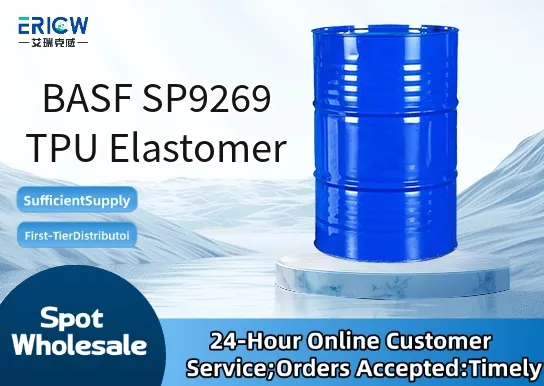
| Chemical Type | Polyester-based thermoplastic polyurethane (TPU) |
| Product Form | Natural-colored granules, free-flowing, dry-blend ready |
| Appearance | Opaque, beige to light tan pellets |
| Primary Applications | Injection molding, extrusion, blow molding |
| Key Features | Abrasion resistance, elasticity, hydrolysis resistance, low-temp flexibility |
| Benefits | Reduced part wear, design freedom for thin-walled structures, consistent processing window |
| Density (g/cm³) | 1.20 ± 0.02 |
| Melt Flow Index (230 °C/2.16 kg, g/10 min) | 15–25 |
Q1: What is the primary functional role of SP9269 in TPU formulations?
A: SP9269 is a high-performance processing aid designed to improve melt flow and reduce extrusion torque during TPU compounding and melt processing. It enhances surface finish, reduces die buildup, and supports consistent pelletization—particularly beneficial for thermally sensitive or high-viscosity TPU grades.
Q2: Is SP9269 compatible with both aromatic and aliphatic TPU systems?
A: Yes, SP9269 demonstrates broad compatibility across aromatic, aliphatic, and polyester-based TPU matrices. Its non-reactive, low-volatility structure ensures stable dispersion without compromising mechanical properties or long-term hydrolytic stability under standard processing conditions.
Q3: How should SP9269 be incorporated into TPU production?
A: SP9269 is typically introduced during the final stage of dry blending or via side-feeding in twin-screw extrusion. It disperses readily at standard TPU processing temperatures (170–220 °C) and does not require pre-drying. Uniform distribution is achieved without extended residence time or additional compatibilizers.
Q4: Does SP9269 affect the regulatory compliance status of finished TPU compounds?
A: SP9269 is formulated to support regulatory flexibility: it contains no intentionally added heavy metals, phthalates, or PFAS, and is suitable for applications where general food-contact or skin-contact safety is required—subject to final formulation validation and end-use testing per applicable regional requirements.
Contact With Us:
E-mail: wangxingqiang@ericwchem.com
Have a Questions? Call Us:
Add:
Building A1, Jiete Industrial Park, Huangpu District, Guangzhou City, Guangdong Province, China