English
 Español
 tiếng việt
 русский
High solids content for reduced VOC emissions and improved coating efficiency.
Excellent chemical resistance to solvents, cleaning agents, and mild acids.
Outstanding flexibility and impact resistance on diverse substrates.
Good compatibility with acrylics, melamines, and other common crosslinkers.
Optimized for ambient or low-bake curing conditions (60–80 °C).
Automotive interior trim coatings (dashboard, door panels, consoles).
Industrial plastic coatings for appliances and electronic housings.
Coatings for rigid PVC and ABS substrates in architectural and consumer goods.
Protective topcoats for flexible and semi-rigid polymeric components.
Two-component (2K) clearcoats requiring high clarity and mar resistance.
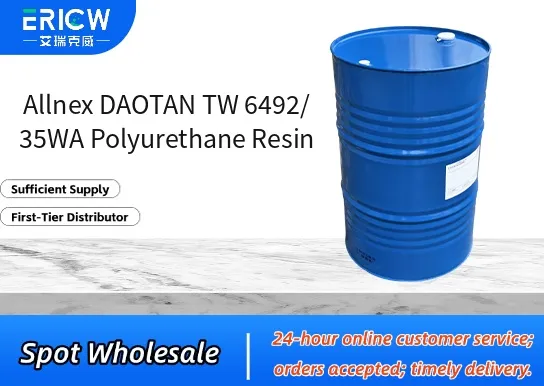
| Chemical Type | Aliphatic polyurethane dispersion |
| Product Form | Waterborne liquid resin |
| Appearance | Opaque white to off-white dispersion |
| Solids Content (wt%) | 35 ± 1 % |
| pH | 7.5 – 8.5 |
| Viscosity (mPa·s, Brookfield RVT, spindle #2, 20 rpm) | 150 – 350 |
| Density (g/cm³, 20 °C) | 1.02 – 1.05 |
| Primary Applications | Plastic coatings, automotive interiors, industrial protective finishes |
Q1: What is the primary function of DAOTAN TW 6492/35WA in polyurethane systems?
A: DAOTAN TW 6492/35WA is a waterborne polyurethane dispersion designed to serve as a film-forming binder or performance modifier in high-performance coatings and adhesives. It contributes flexibility, abrasion resistance, and good low-temperature film formation without requiring organic co-solvents.
Q2: Is DAOTAN TW 6492/35WA compatible with common crosslinkers used in industrial PU coatings?
A: Yes, it is formulated to be compatible with standard aqueous or blocked isocyanate crosslinkers, as well as carbodiimide or aziridine-based curing agents. Compatibility and cure profile should be verified experimentally within the final formulation due to sensitivity to pH, ionic strength, and mixing sequence.
Q3: How should DAOTAN TW 6492/35WA be stored and handled to maintain stability?
A: Store in tightly sealed containers at temperatures between 5 °C and 30 °C, away from freezing conditions and direct sunlight. Avoid prolonged exposure to high humidity or contamination with incompatible materials such as strong acids, bases, or certain surfactants that may destabilize the dispersion.
Q4: Can DAOTAN TW 6492/35WA be blended with acrylic dispersions or other polymer emulsions?
A: It is generally compatible with many anionic and non-ionic acrylic dispersions, but compatibility must be assessed case-by-case. Blending may affect viscosity, storage stability, film clarity, and mechanical properties—preliminary compatibility testing and stability monitoring over time are strongly recommended.
Contact With Us:
E-mail: wangxingqiang@ericwchem.com
Have a Questions? Call Us:
Add:
Building A1, Jiete Industrial Park, Huangpu District, Guangzhou City, Guangdong Province, China