English
 Español
 tiếng việt
 русский
High transparency and excellent optical clarity for premium finish applications.
Outstanding weather resistance and UV stability, minimizing yellowing and gloss loss over time.
Good compatibility with common solvent-based coating systems and crosslinkers.
Low viscosity in standard solvents, enabling easy handling and efficient spray or roll-coating application.
Consistent batch-to-batch reproducibility backed by stringent quality control standards.
Automotive clearcoats and topcoats requiring high-gloss, durable finishes.
Industrial maintenance coatings for metal and plastic substrates.
Architectural coatings including exterior façade and cladding systems.
Refinish coatings for OEM and aftermarket automotive repair.
High-performance protective coatings for signage and display panels.
| Chemical Type | Acrylic copolymer resin |
| Product Form | Solvent solution (typically in aromatic hydrocarbons and/or ester blends) |
| Appearance | Clear, colorless to pale yellow liquid |
| Solids Content | Approx. 50 ± 2 wt% (as supplied) |
| Acid Value | 15–25 mg KOH/g |
| Hydroxyl Value | 40–60 mg KOH/g |
| Viscosity (25°C, #4 Ford Cup) | 18–24 seconds |
| Primary Applications | Two-component (2K) polyurethane and amino-cured thermoset coatings |
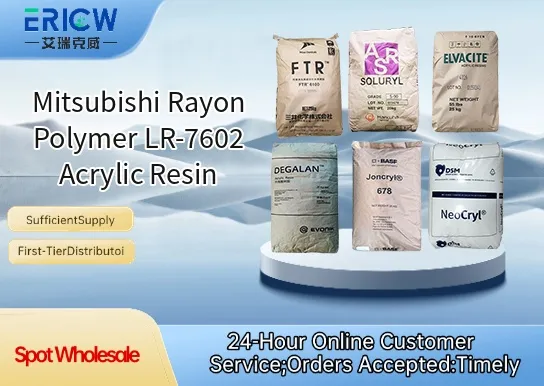
Q1: What is the primary function of LR-7602 in coating formulations?
A: LR-7602 is a specialty acrylic polymer designed primarily as a rheology modifier and matting agent in solvent-based and high-solids industrial coatings. It helps control flow, reduce gloss, and enhance surface texture without significantly compromising film integrity or clarity.
Q2: Is LR-7602 compatible with common crosslinkers used in thermosetting acrylic systems?
A: Yes, LR-7602 demonstrates good compatibility with melamine-formaldehyde, urea-formaldehyde, and polyisocyanate crosslinkers typically employed in baking enamels and two-component polyurethane systems. Compatibility should be verified under actual formulation conditions due to sensitivity to solvent polarity and acid value.
Q3: How is LR-7602 typically incorporated into a coating formulation?
A: LR-7602 is generally added during the let-down stage, dispersed using high-shear mixing in suitable solvents such as xylene, toluene, or ketones. Pre-dispersion in a portion of the vehicle resin or solvent prior to incorporation is recommended to ensure uniform distribution and optimal performance.
Q4: Does LR-7602 require post-addition stabilization or pH adjustment?
A: LR-7602 is supplied as a stable dispersion and does not require pH adjustment. However, its performance may be affected by strongly acidic or alkaline additives; therefore, it is advisable to avoid co-addition with low-pH catalysts or amine-based dispersants unless compatibility testing confirms stability.
Contact With Us:
E-mail: wangxingqiang@ericwchem.com
Have a Questions? Call Us:
Add:
Building A1, Jiete Industrial Park, Huangpu District, Guangzhou City, Guangdong Province, China