English
 Español
 tiếng việt
 русский
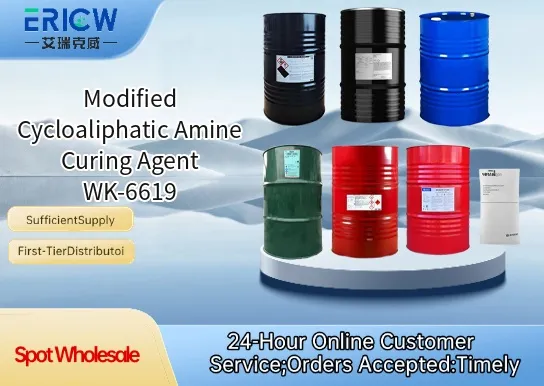
Enhanced pot life compared to standard aliphatic amines, enabling extended working time at ambient temperature.
Improved thermal and chemical resistance in cured epoxy systems due to rigid cycloaliphatic backbone structure.
Low volatility and reduced skin irritation potential, supporting safer handling in industrial environments.
Excellent adhesion to metallic, concrete, and composite substrates without requiring surface priming.
Compatible with standard DGEBA and modified epoxy resins, offering broad formulation flexibility.
High-performance epoxy coatings for industrial flooring and chemical containment areas.
Structural adhesive formulations for aerospace and wind turbine blade assembly.
Electrical encapsulation and potting compounds requiring low exotherm and high dielectric strength.
Repair mortars and polymer-modified grouts for infrastructure rehabilitation projects.
Marine-grade protective coatings exposed to saltwater and UV degradation.
| Chemical Type | Modified cycloaliphatic amine |
| Product Form | Liquid |
| Appearance | Pale yellow to amber clear liquid |
| Primary Applications | Epoxy coating, adhesive, and encapsulation systems |
| Key Features | Extended pot life, low volatility, high Tg capability |
| Benefits | Improved safety profile, substrate versatility, thermal stability |
| Storage Condition | Store in original sealed container at 10–30 °C, protect from moisture |
| Shelf Life | 12 months from date of manufacture under recommended storage |
Q1: What are the key advantages of WK-6619 compared to conventional aliphatic or aromatic amine curing agents?
A: WK-6619 offers an optimized balance of low viscosity, reduced volatility, and improved compatibility with epoxy resins—enabling easier handling and longer pot life than many standard aliphatic amines. Its modified cycloaliphatic structure also delivers enhanced thermal stability and mechanical performance in cured systems, without the toxicity or discoloration risks associated with aromatic amines.
Q2: How does WK-6619 perform in high-gloss, UV-stable coatings applications?
A: Due to its saturated cycloaliphatic backbone and structural modification, WK-6619 contributes to excellent UV resistance and minimal yellowing upon aging—making it well-suited for high-performance clear coats and decorative surface finishes where long-term gloss retention and color stability are critical.
Q3: Is WK-6619 compatible with standard DGEBA-type epoxy resins and novolac epoxies?
A: Yes, WK-6619 demonstrates broad compatibility with common diglycidyl ether of bisphenol-A (DGEBA) resins, as well as higher-functionality novolac epoxies. It typically cures at ambient to moderate elevated temperatures (e.g., 20–80 °C), with reactivity and final properties adjustable via formulation tuning.
Q4: What safety and handling considerations apply to WK-6619?
A: WK-6619 is formulated to exhibit lower skin sensitization potential and reduced vapor pressure relative to unmodified primary aliphatic amines. Standard industrial hygiene practices—including adequate ventilation, gloves, and eye protection—are recommended during handling. Full safety information is provided in the current Safety Data Sheet (SDS).
Contact With Us:
E-mail: wangxingqiang@ericwchem.com
Have a Questions? Call Us:
Add:
Building A1, Jiete Industrial Park, Huangpu District, Guangzhou City, Guangdong Province, China